How to Do a Pike Push-Up Correctly: Step-by-Step Guide for Beginners

Learn how to do pike push-ups with perfect form, avoid common mistakes, and discover the best variations to build shoulder strength and overhead pressing power.

Pike push-ups are one of the most effective bodyweight exercises for developing strong shoulders, triceps, and upper-body pressing strength. Whether you are training for calisthenics, military fitness tests, or handstand push-up progressions, mastering pike push-ups is essential.


What Are Pike Push-Ups?

A pike push-up is a bodyweight exercise in which you perform a push-up with your hips elevated, shifting more of the workload onto your shoulders.

The movement mimics the overhead pressing pattern used in handstand push-ups, making it one of the best exercises for building vertical pushing strength.

Pike push-ups are commonly used in:

  • Calisthenics training
  • Handstand push-up progressions
  • Bodyweight strength programs
  • Athletic conditioning routines

Unlike standard push-ups, pike push-ups place greater emphasis on the shoulders and upper chest.

Benefits of Pike Push-Ups

Pike push-ups are one of the best exercises for developing upper-body pressing strength.

Benefits include:

  • Builds strong shoulders and triceps
  • Develops overhead pressing strength
  • Improves shoulder stability
  • Strengthens the upper chest
  • Enhances body control and coordination
  • Prepares you for handstand push-ups

Few bodyweight exercises build shoulder strength as effectively as pike push-ups.

Muscles Worked in Pike Push-Ups

Pike push-ups activate multiple upper-body muscles simultaneously.

Primary Muscles
  • Shoulders (Anterior Deltoids)
  • Triceps
Secondary Muscles
  • Upper Chest (Clavicular Pectorals)
  • Core Muscles
  • Serratus Anterior
  • Upper Trapezius

Because of this muscle activation, pike push-ups are one of the best bodyweight alternatives to overhead presses.


How to Do Pike Push-Ups (Step-by-Step)

Step 1: Get Into the Pike Position

Start in a push-up position and raise your hips toward the ceiling.

  • Hands shoulder-width apart
  • Arms straight
  • Legs straight if flexibility allows

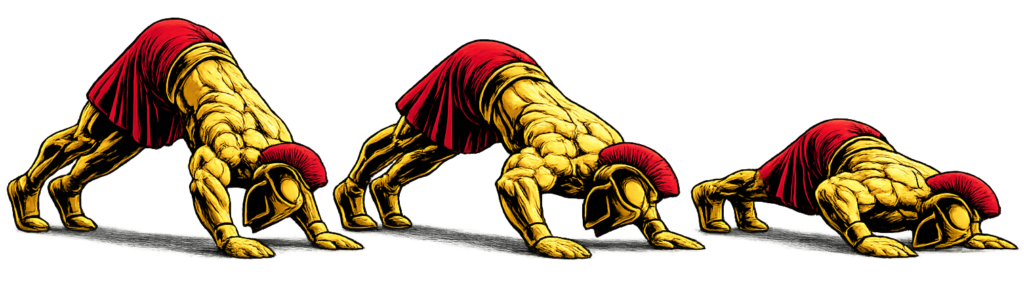
Your body should form an inverted “V” shape.

Tip: The higher your hips, the more emphasis you place on your shoulders.

Step 2: Engage Your Core

Before lowering:

  • Tighten your abs
  • Squeeze your glutes
  • Keep your spine neutral

This helps maintain stability throughout the movement.

Warrior showcasing How to do Pike Push-Ups with proper form

Step 3: Lower Your Head Toward the Ground

Bend your elbows and slowly lower yourself.

Focus on bringing the top of your head toward the floor between your hands.

Avoid lowering your chest like a standard push-up.

Warrior showcasing How to do Pike-Push-Ups progressively

Step 4: Reach the Bottom Position

At the bottom:

  • Head is close to the ground
  • Elbows remain controlled
  • Core stays tight

Pause briefly while maintaining tension.

Step 5: Press Back Up

Push through your palms and extend your elbows until you return to the starting position.

Keep the movement smooth and controlled.


Pike Push-Up Form Checklist

Use this quick checklist to ensure perfect form.

  • Keep hips elevated throughout the movement
  • Lower your head between your hands
  • Maintain a tight core
  • Control the lowering phase
  • Lock out fully at the top

Perfect form builds strength faster and reduces the risk of injury.


Common Pike Push-Up Mistakes

Dropping the Hips

Problem: Turns the movement into a regular push-up.

Fix: Keep your hips elevated throughout the exercise.

Flaring the Elbows Excessively

Problem: Places unnecessary stress on the shoulders.

Fix: Keep elbows at a controlled angle during each rep.

Looking Forward

Problem: Creates neck strain and poor alignment.

Fix: Keep your head neutral and focus on the floor.

Partial Range of Motion

Problem: Limits strength development.

Fix: Lower until your head nearly touches the ground.

Rushing the Movement

Problem: Reduces muscle activation.

Fix: Use a controlled tempo:

  • 1–2 seconds down
  • Brief pause
  • Explode upward

Quality repetitions always beat sloppy reps.


Pike Push-Up Variations

Once you master the basic pike push-up, these variations can help build more strength and progress toward advanced skills.

Incline Pike Push-Ups

A beginner-friendly variation that reduces difficulty.

How to Do Incline Pike Push-Ups

  • Place your hands on an elevated surface
  • Raise your hips into a pike position
  • Perform the movement with control

This variation is ideal for beginners.

Elevated Feet Pike Push-Ups

Increases shoulder loading significantly.

How to Do Elevated Feet Pike Push-Ups

  • Place your feet on a box or bench
  • Raise hips high
  • Lower your head toward the floor

This variation closely resembles a handstand push-up.

Deficit Pike Push-Ups

Improves range of motion and strength.

How to Do Deficit Pike Push-Ups

  • Place hands on parallettes or blocks
  • Lower deeper than normal
  • Press back up under control

This variation builds strength through a greater range of motion.

Wall-Assisted Handstand Push-Ups

The next progression after mastering pike push-ups.

How to Do Wall-Assisted Handstand Push-Ups

  • Kick into a wall-supported handstand
  • Lower your head toward the ground
  • Press back upward

This progression develops true vertical pressing strength.


Final Thoughts

The pike push-up is one of the most effective bodyweight shoulder exercises you can master.

It builds:

  • Shoulder strength
  • Triceps strength
  • Upper chest development
  • Core stability
  • Handstand push-up readiness

Progress may feel challenging at first, especially if shoulder strength is limited. However, with consistent training and proper form, your pressing power will steadily improve. Learn more about Push Workouts here.

Focus on quality repetitions, controlled movement, and full range of motion.

A warrior presses upward with strength — never with shortcuts.

Essential Gear for Pike Push-Ups

The right equipment can improve your pressing performance, support proper technique, and help you progress safely as your shoulder strength increases. Here are the essentials every warrior should consider.

  • Push-Up Handles: Increase your range of motion, keep your wrists in a more neutral position, and make pike push-ups and deficit pike push-ups more comfortable and effective.
  • Wrist Wraps: Provide extra wrist support and stability during pike push-ups, helping reduce discomfort while maintaining proper pressing alignment.
  • Resistance Bands: Ideal for shoulder warm-ups, mobility work, and assisted handstand push-up progressions as you advance beyond pike push-ups.
  • Exercise Mat: Creates a stable, non-slip training surface that improves comfort for your hands and provides cushioning during floor-based shoulder training.
  • Weighted Vest: An excellent way to progressively increase resistance once standard pike push-ups become easy, helping build greater overhead pressing strength before advancing to handstand push-ups.

These simple training tools can make your pike push-up workouts safer, more comfortable, and more effective while helping you develop the shoulder strength needed for advanced vertical pushing exercises.


Pike Push-Up FAQ

Q1: Are pike push-ups better than regular push-ups for shoulders?
Yes. Pike push-ups place significantly more emphasis on the shoulders, making them one of the best bodyweight shoulder exercises.

Q2: How many pike push-ups should a beginner do?
Most beginners can start with 5–10 controlled repetitions per set and gradually increase volume over time.

Q3: Do pike push-ups help with handstand push-ups?
Absolutely. Pike push-ups are one of the best progressions for developing the strength and movement pattern needed for handstand push-ups.

Progress Tracking Tools: How to Track Your Fitness Like a Warrior

What Are Progress Tracking Tools?

Progress tracking tools are simple methods used to record your workouts, performance, body changes, and consistency over time. Instead of guessing whether you’re improving, these tools give you clear data about your strength, endurance, and discipline.

For a warrior, tracking progress is not optional — it is the key to continuous improvement and long-term success.


Why Progress Tracking Matters

Tracking your training helps you:

  • Stay consistent and accountable
  • Measure strength and endurance improvements
  • Identify weaknesses early
  • Avoid plateaus
  • Stay motivated by seeing results
  • Set realistic goals

When you see your numbers improve — more pushups, faster runs, longer hangs — your motivation increases automatically.


Types of Progress Tracking Tools

1. Workout Log

Record:

  • Exercises performed
  • Sets and reps
  • Weight used (if any)
  • Total workout time

This helps you apply progressive overload, the main principle behind muscle growth and strength.

Weekly Workout Tracker

WeekMonTueWedThuFriSatNotes
1
2
3
4

2. Strength Benchmarks

Track your personal bests, such as:

  • Maximum pushups
  • Maximum pullups
  • Plank time
  • Dead hang time
  • Squat reps

Test these every 2–4 weeks.

Strength Progress Tracker

ExerciseWeek 1Week 2Week 3Week 4
Pushups (max)
Pullups (max)
Squats (max)
Plank time
Dead hang

3. Running & Endurance Tracker

Record:

  • Distance covered
  • Time taken
  • Pace per mile
  • Number of laps

This is essential for military and endurance training.

Running Progress Tracker

DateDistanceTimePaceNotes

4. Body Progress Tracking

Measure every 2–3 weeks:

  • Body weight
  • Chest circumference
  • Waist size
  • Arm size
  • Thigh size

Photos (front, side, back) are even more powerful than numbers.

Body Measurement Tracker

MeasurementWeek 1Week 4Week 8
Weight
Chest
Waist
Arms
Thighs

5. Consistency Tracker

Sometimes the most important metric is simply:

Did you train today?

Mark each completed workout to build discipline.


How to Use Progress Tracking Tools Effectively

  • Write your results immediately after each workout
  • Review your numbers every week
  • Aim to improve at least one metric each session
  • Test maximum performance once every 2–4 weeks
  • Focus on long-term improvement, not daily fluctuations

Remember: progress is slow but powerful when tracked.


5. Monthly Performance Test

Test once per month:

  • Max pushups
  • Max pullups
  • 1-mile run time
  • Plank max time
  • Dead hang max time

Record results and compare with previous months.


Final Thoughts

What gets measured gets improved. Progress tracking turns training into a mission, not a guess. When you record your performance and stay consistent, small improvements compound into powerful results.

Train hard. Track everything. Become unstoppable. Remember (1)365 is still 1; But (1.01)365 is 37.78. Improve 0.01 everyday and you will reinvent yourself in a year.

Beginner At-Home PPL Workout Plan (Push-Pull-Legs)

This Beginner At-Home PPL Workout Plan uses a Push-Pull-Legs (PPL) structure to train your entire body while giving your muscles time to recover. You can choose between a 3-day PPL routine, which is recommended for most complete beginners, or a 6-day PPL routine if you already exercise regularly and recover well.

Training at home is one of the simplest ways for beginners to start building strength, muscle, endurance, and consistency. You don’t need a fully equipped gym to make progress—a few basic pieces of equipment and a structured training plan can take you a long way.

The goal isn’t to destroy yourself every workout. It’s to master the basic movements, gradually become stronger, and build the foundation needed for more challenging training later.

Click on any exercise to learn How to do it.

Benefits of a Beginner At-Home PPL Plan

  • Builds foundational strength and muscle
  • Trains every major muscle group
  • Develops muscular endurance
  • Improves movement quality and body control
  • Provides plenty of recovery with the 3-day option
  • Requires minimal home equipment
  • Makes progressive overload easy to track
  • Creates a foundation for intermediate training

Equipment Needed

You don’t need a complete home gym for this program.

A pull-up bar and resistance bands are especially useful for Pull Day. If you don’t have them yet, use the exercise alternatives listed in the workouts.


What Is a Push Pull Legs (PPL) Split?

Push Pull Legs divides your training according to movement patterns and the muscles performing them:

  • Push Day – Chest, shoulders, and triceps
  • Pull Day – Back and biceps
  • Leg Day – Quads, hamstrings, glutes, and calves

Instead of training your entire body during every session, each workout focuses on related muscle groups.

Beginners can perform each workout once per week with the 3-day version or twice per week with the 6-day version.


Weekly Training Structure

Option 1 – 3-Day Beginner PPL

  • Monday – Push
  • Tuesday – Rest
  • Wednesday – Pull
  • Thursday – Rest
  • Friday – Legs
  • Saturday – Rest or Light Activity
  • Sunday – Rest

This is the recommended starting option for complete beginners.

Training three days per week provides plenty of recovery while you learn proper technique and allows your muscles and joints to adapt to resistance training.

Option 2 – 6-Day Beginner PPL

  • Monday – Push
  • Tuesday – Pull
  • Wednesday – Legs
  • Thursday – Push
  • Friday – Pull
  • Saturday – Legs
  • Sunday – Rest

Choose the 6-day option if you already have a basic fitness foundation, enjoy frequent training, and recover comfortably between sessions.

Do not perform both options together. Choose one weekly structure and follow it consistently.


Pre-Workout Warm-Up Routine

Perform this routine before every workout for approximately 5–8 minutes.

The goal is to gradually raise your heart rate and prepare the joints and muscles you are about to train.


Push Day Workout (Chest, Shoulders, Triceps)

Main Workout

Rest 60–90 seconds between sets.

Can’t Do Push-Ups Yet?

Start with:

Wall Push-Ups → Incline Push-Ups → Knee Push-Ups → Standard Push-Ups

Don’t force standard push-ups with poor technique just to meet the prescribed reps.

Core Finisher

  • Plank – 3 sets × 20–30 seconds
  • Dead Bug – 2 sets × 8–10 reps each side

Pull Day Workout (Back, Biceps)

Main Workout

  • Assisted Pull-Ups – 3 sets × 4–8 reps
  • Inverted Rows – 3 sets × 6–12 reps
  • Resistance Band Rows – 3 sets × 10–15 reps
  • Backpack or Resistance Band Bicep Curls – 2 sets × 10–15 reps

Rest 60–90 seconds between sets.

Can’t Do Pull-Ups Yet?

That’s completely normal for a beginner.

Build toward them using:

Dead Hangs → Scapular Pull-Ups → Inverted Rows → Band-Assisted Pull-Ups → Pull-Ups

If you don’t own a pull-up bar, prioritize secure rows and resistance-band pulling exercises until you have access to one.

Core Finisher

  • Lying Knee Raises – 3 sets × 10–12 reps
  • Bird Dog – 2 sets × 10 reps each side

Legs Day Workout (Quads, Hamstrings, Glutes, Calves)

Main Workout

Rest 60–90 seconds between sets.

The Romanian Deadlift adds an important hip-hinge movement to the program and gives the hamstrings more direct work than the old version of this plan.

If you’re completely new to the movement, learn the hip hinge with little or no backpack resistance before gradually adding weight.

Core Finisher


Post-Workout Stretch Routine

After training, allow your breathing and heart rate to settle before performing comfortable static stretches.

Hold each stretch for approximately 20–30 seconds.

You don’t need to force yourself deeper into a stretch. Use a comfortable range and relax into each position.


How to Progress as a Beginner

Your body eventually adapts to the same workload, so the exercises must gradually become more challenging.

Use double progression for this plan.

For example, if Push-Ups are prescribed for:

3 sets × 6–12 reps

You might progress like this:

Week 1: 8, 7, 6
Week 2: 9, 8, 7
Week 3: 10, 9, 8
Week 4: 12, 11, 10
Week 5: 12, 12, 12

Once you can perform the top of the rep range across every set with good form, make the exercise slightly harder.

You can progress by:

  • Adding repetitions
  • Adding a small amount of backpack resistance
  • Using a stronger resistance band
  • Increasing range of motion
  • Progressing to a harder exercise variation
  • Adding a set when appropriate
  • Performing repetitions more slowly and under control

Only change one or two variables at a time.


3-Day or 6-Day: Which Should You Choose?

Choose the 3-day PPL if:

  • You are completely new to working out
  • You haven’t exercised consistently in a long time
  • You experience significant soreness after training
  • You have limited time
  • You participate in sports or other physical activities during the week

Choose the 6-day PPL if:

  • You already have a basic fitness foundation
  • Your technique is consistent
  • You recover comfortably between sessions
  • You enjoy training frequently
  • Your sleep and nutrition support the additional workload

Six days isn’t automatically better than three. A beginner who trains three times per week consistently will make far more progress than someone who attempts six days and repeatedly misses workouts because they cannot recover.


How Long Should You Follow This Plan?

Follow the Beginner At-Home PPL Workout Plan for approximately 8–12 weeks.

You don’t automatically need to leave the program when 12 weeks pass. Continue using it while you’re making progress.

Consider progressing to an intermediate program when:

  • Beginner exercise variations have become easy
  • You can consistently complete the upper end of your rep ranges
  • Your technique is controlled and reliable
  • Your recovery between workouts is good
  • You need greater resistance or more difficult variations to continue progressing

Tips for Beginner Trainees

  • Learn proper technique before worrying about high repetitions.
  • Stop a set when your form begins to break down.
  • Don’t take every exercise to muscular failure.
  • Keep a workout log and record your repetitions.
  • Increase resistance gradually.
  • Eat enough protein and nutritious foods to support training.
  • Stay hydrated throughout the day.
  • Aim for consistent, adequate sleep.
  • Use rest days for recovery, walking, or gentle mobility.
  • Don’t compare your starting point with someone who has trained for years.

Final Thoughts

The Beginner At-Home PPL Workout Plan gives you a simple structure for building strength, muscle, endurance, and training discipline without needing a gym.

If you’re starting from scratch, begin with the 3-day PPL option. Learn the exercises, allow your body to adapt, and focus on consistent progression. If you already have a basic fitness foundation and recover well, the 6-day PPL option lets you train each movement group twice per week.

You don’t need to rush your progress. Master the fundamentals, gradually make your exercises harder, eat and recover properly, and allow months of consistent training to do the work.

Build the foundation now, and you’ll be ready for much harder warrior-level training later.

Gym Training Plans: What They Are and What You Need

Gym Training Plans

Gym training plans are structured workout programs designed to help you build muscle, increase strength, improve endurance, and enhance overall fitness using gym equipment. Unlike random workouts, a proper gym plan follows a systematic approach—targeting specific muscle groups, managing workload, and ensuring steady progress over time.

With access to a wide range of machines, free weights, and training tools, gym plans allow for greater exercise variety and precise muscle development.


What a Gym Training Plan Includes

1. Defined Goals
Every effective plan starts with a clear objective, such as muscle gain, fat loss, strength building, endurance, or overall fitness. Your goal determines exercise selection, training intensity, and weekly frequency.

2. Structured Split Routine
Gym plans are often organized into training splits, such as:

  • Push (chest, shoulders, triceps)
  • Pull (back, biceps)
  • Legs (lower body)
  • Full-body or upper/lower splits

This structure allows proper recovery while maximizing performance.

3. Progressive Overload
Progress is achieved by gradually increasing weight, repetitions, sets, or training intensity to continuously challenge the muscles.


What You Need for Training At the Gym

  • Access to free weights: Dumbbells, barbells, and weight plates
  • Resistance machines: For controlled and targeted muscle training
  • Cardio equipment: Treadmill, rowing machine, or cycling
  • Training plan or log: To track weights, reps, and progress
  • Proper gym form and technique: To maximize results and prevent injury

Supporting Factors for Success

  • Balanced nutrition to support performance and recovery
  • Adequate rest and sleep
  • Proper warm-up and mobility work
  • Consistency and discipline over time

Final Thoughts

A gym training plan provides structure, variety, and the tools needed to safely and effectively push your limits. With clear goals, progressive training, and consistency, the gym becomes a powerful environment for building strength, muscle, and long-term fitness.

Home Training Plans: What They Are and What You Need to Get Started

Training Plans at Home

Home training plans are structured workout routines designed to help you build strength, endurance, and overall fitness without going to a gym. Instead of random exercises, a home training plan follows a clear schedule, targets specific muscle groups, and ensures steady progress over time. Whether your goal is muscle gain, fat loss, improved stamina, or military-level fitness, a well-designed plan keeps your training focused, efficient, and consistent.


What a Home Training Plan Includes

A good home training plan is built around three key elements:

1. Clear Goals
Your plan should match your objective—strength, muscle building, weight loss, endurance, or overall fitness. Clear goals help determine exercise selection, intensity, and weekly frequency.

2. Structured Routine
Most effective plans organize workouts by:

  • Muscle groups (push, pull, legs, core)
  • Training days (e.g., 4–6 days per week)
  • Progression (increasing reps, sets, or resistance over time)

3. Consistency and Progression
Progress comes from gradually increasing difficulty—more reps, longer runs, slower tempos, or added weight.


What You Need for Home Training

You don’t need a full gym. Most home training plans require only basic equipment:

  • Bodyweight foundation: Push-ups, squats, lunges, planks, pull-ups
  • Pull-up bar: Essential for back and upper-body strength
  • Resistance bands: Great for assistance and added resistance
  • Weighted backpack or household weights: For progressive overload
  • Open space: For running, conditioning, or mobility work
  • Training schedule or tracker: To monitor progress and stay disciplined

Supporting Factors for Success

  • Proper nutrition to fuel recovery and muscle growth
  • Adequate sleep (7–9 hours)
  • Warm-up and stretching to prevent injuries
  • Discipline and patience for long-term results

Final Thoughts

Home training plans prove that results don’t depend on a gym—only on structure, consistency, and effort. With the right plan and basic tools, you can build strength, endurance, and a warrior-level physique right from home.

Workout Nutrition Guide: How to Fuel Your Training

Training gives your body a reason to become stronger. Nutrition gives it the energy and raw materials to actually do it.

You can follow an excellent workout program, push yourself hard, and stay consistent—but if you regularly underfuel, eat too little protein, neglect hydration, or fail to support recovery, your progress can suffer.

Good workout nutrition does not require a perfect diet, expensive supplements, or eating six meals every day. It comes down to consistently giving your body enough energy, protein, carbohydrates, healthy fats, micronutrients, and fluids for your goals.

Whether you train for muscle growth, calisthenics, strength, fat loss, combat sports, endurance, or general fitness, this guide will teach you the foundations of fueling your body properly.

Quick Answer

For most people, effective workout nutrition comes down to six priorities:

  • Eat enough total calories for your goal.
  • Consume enough protein every day.
  • Use carbohydrates to support training and recovery.
  • Include sufficient dietary fat for overall health.
  • Eat mostly nutrient-dense whole foods.
  • Stay properly hydrated.

Meal timing can improve comfort, performance, and recovery, but your overall daily nutrition matters more than hitting a perfect 30-minute eating window.

Supplements can help in certain situations, but they should support a good diet rather than replace one.


What Is Workout Nutrition?

Workout nutrition is the way you organize your food and fluid intake to support exercise performance, recovery, body composition, and long-term health.

It includes much more than simply eating something before and after training.

Your workout nutrition includes:

  • Total daily calorie intake
  • Protein intake
  • Carbohydrate intake
  • Dietary fats
  • Vitamins and minerals
  • Hydration and electrolytes
  • Pre-workout meals
  • Post-workout meals
  • Meal timing
  • Food quality
  • Supplements

The best nutrition strategy depends on what you are trying to accomplish.

Someone trying to gain muscle usually needs a different calorie intake than someone trying to lose fat, while an endurance athlete may require considerably more carbohydrates than someone performing a short strength workout.

That is why there is no single “perfect diet” for everyone.


Why Nutrition Matters for Training

Your workouts create the stimulus for adaptation, but your body still needs adequate nutrition to respond to that stimulus.

Better Training Performance

Food provides the energy required to train intensely.

Carbohydrates are particularly useful during moderate-to-high-intensity exercise because stored carbohydrate, known as glycogen, can be used rapidly by working muscles.

If you consistently train while poorly fueled, you may notice:

  • Lower energy
  • Reduced training volume
  • Earlier fatigue
  • Poor concentration
  • Decreased performance

Muscle Growth and Repair

Resistance training stimulates changes within muscle tissue.

Dietary protein provides the amino acids your body uses to repair and build muscle proteins after training.

Consistently eating adequate protein is therefore one of the most important nutritional habits for anyone trying to gain or maintain muscle.

Faster Recovery

Recovery requires more than simply resting.

Your body needs:

  • Protein for muscle repair
  • Carbohydrates to replenish glycogen
  • Fluids to restore hydration
  • Minerals lost through sweat
  • Enough total energy to support recovery

Proper nutrition helps prepare you for your next training session.

Better Body Composition

Nutrition ultimately determines whether you are regularly consuming more, fewer, or approximately the same number of calories as your body uses.

That makes calorie intake one of the major factors controlling whether bodyweight generally:

  • Increases
  • Decreases
  • Remains stable

Training and protein intake then help influence how much muscle you maintain or gain during those changes.

Better Overall Health

Performance should not come at the expense of health.

A varied diet containing fruits, vegetables, whole grains, legumes, dairy or suitable alternatives, healthy fats, and quality protein sources helps provide the vitamins, minerals, fiber, and other nutrients your body needs beyond the gym.


The Most Important Principle: Your Total Diet Comes First

People often focus on small details before getting the fundamentals right.

They worry about whether they should eat their banana 30 or 45 minutes before training while ignoring the fact that they have barely eaten enough throughout the day.

Your priorities should generally look like this:

  1. Appropriate calorie intake
  2. Adequate protein
  3. Adequate carbohydrates and fats
  4. Good food quality and micronutrient intake
  5. Hydration
  6. Meal distribution and timing
  7. Supplements

The higher items on that list usually matter more than the lower ones.

A perfectly timed protein shake cannot compensate for consistently eating too little protein.

A pre-workout supplement cannot compensate for chronic lack of sleep and insufficient food.

And one “perfect” meal cannot compensate for an otherwise poor diet.

Build the foundation first.


Calories: Fuel for Everything

Calories measure the energy contained in food.

Your body uses energy constantly for:

  • Breathing
  • Circulation
  • Digestion
  • Brain function
  • Maintaining body temperature
  • Daily movement
  • Exercise
  • Tissue repair

Your calorie needs therefore depend on factors including:

  • Bodyweight
  • Height
  • Age
  • Sex
  • Muscle mass
  • Daily activity
  • Training volume
  • Training intensity
  • Goal

For Muscle Gain

You generally need enough calories to support training and provide the body with the resources required to gain tissue.

A moderate calorie surplus is usually preferable to aggressively overeating.

For Fat Loss

Fat loss requires a sustained calorie deficit, meaning you consume less energy than you expend over time.

The goal should usually be to create a manageable deficit while continuing to:

  • Strength train
  • Eat adequate protein
  • Sleep sufficiently
  • Maintain training performance as much as possible

For Maintenance

If your goal is maintaining your current bodyweight and composition, your average intake should roughly match your average energy expenditure.

Exact intake does not need to be identical every single day.

What matters is the overall trend.

Protein: The Foundation for Muscle Recovery

Protein is essential for muscle growth, muscle maintenance, tissue repair, enzymes, hormones, and many other biological functions.

For active individuals, protein requirements are generally higher than those of sedentary people.

A commonly useful range for people performing regular resistance training is approximately:

1.6–2.2 grams of protein per kilogram of bodyweight per day

For example, a 70 kg person could aim for roughly:

  • 70 × 1.6 = 112 g
  • 70 × 2.2 = 154 g

That gives a practical range of approximately 112–154 grams of protein per day.

You do not necessarily need the upper end of the range to make progress.

People dieting aggressively, training frequently, or simply preferring a higher-protein diet may benefit from consuming toward the higher end.

Good Protein Sources

Animal-based options include:

  • Eggs
  • Chicken
  • Fish
  • Lean beef
  • Milk
  • Yogurt
  • Cottage cheese
  • Whey protein

Plant-based options include:

  • Lentils
  • Chickpeas
  • Beans
  • Soy
  • Tofu
  • Peas
  • Nuts and seeds
  • Plant protein powders

A mixed diet can easily combine several of these.

Spread Protein Across the Day

Instead of eating nearly all your protein at dinner, it is generally practical to divide it between several meals.

For example:

  • Breakfast: eggs + milk
  • Lunch: chicken + rice
  • Snack: yogurt
  • Dinner: Lentils + meat or another protein source

Total daily intake remains the main priority.

Carbohydrates: Your Main High-Intensity Training Fuel

Carbohydrates are often unnecessarily demonized.

For people who train hard, they can be extremely useful.

Your body stores carbohydrate primarily as glycogen in the muscles and liver. Muscle glycogen is an important fuel source during activities such as:

  • Resistance training
  • Calisthenics
  • Sprinting
  • Combat sports
  • Circuit training
  • Running
  • High-intensity conditioning

Higher training volumes generally increase carbohydrate requirements.

Good Carbohydrate Sources

  • Rice
  • Whole-wheat Flatbread
  • Oats
  • Potatoes
  • Sweet potatoes
  • Whole-grain bread
  • Pasta
  • Bananas
  • Dates
  • Apples
  • Other fruits
  • Beans
  • Lentils
  • Chickpeas

Refined carbohydrates are not automatically “bad,” either.

Foods such as white rice or white bread can sometimes be useful around workouts because they are relatively easy to digest.

Do You Need to Avoid Carbs at Night?

No.

Carbohydrates do not suddenly become body fat because the sun goes down.

Your total calorie intake, food quality, activity level, and overall dietary pattern matter considerably more than whether you eat rice at 4 PM or 9 PM.

If eating carbohydrates with dinner fits your calories and helps you recover, there is no general reason to avoid them.

Dietary Fat: Essential, Not the Enemy

Dietary fat is another nutrient that should neither be feared nor consumed without limit.

Fat plays important roles in:

  • Cell structure
  • Hormone production
  • Absorption of vitamins A, D, E, and K
  • Providing energy
  • Supporting overall health

Good Fat Sources

  • Nuts
  • Seeds
  • Olive oil
  • Peanut butter
  • Egg yolks
  • Avocado
  • Fatty fish

Because dietary fat is calorie-dense, portions can add up quickly.

For example, a few spoonfuls of oil or a large quantity of nuts can contain hundreds of calories.

That does not make these foods unhealthy—it simply means portion size matters, especially during fat loss.

Vitamins and Minerals: The Small Nutrients With Big Jobs

Macronutrients receive most of the attention in fitness nutrition, but vitamins and minerals are also essential.

Micronutrients contribute to processes involving:

  • Energy metabolism
  • Muscle contraction
  • Bone health
  • Oxygen transport
  • Immune function
  • Fluid balance
  • Recovery

Important nutrients include:

Vitamin D

Supports bone health, muscle function, and many other physiological processes.

Sources include:

  • Sunlight exposure
  • Egg yolks
  • Fatty fish
  • Fortified foods

Calcium

Important for bones and muscle contraction.

Sources include:

  • Milk
  • Yogurt
  • Cheese
  • Fortified alternatives
  • Certain leafy greens

Iron

Iron is important for oxygen transport.

Sources include:

  • Red meat
  • Liver
  • Lentils
  • Beans
  • Leafy vegetables

People with suspected iron deficiency should not blindly take high-dose iron supplements. Deficiency should ideally be evaluated properly.

Magnesium

Magnesium participates in numerous processes related to muscle function and metabolism.

Sources include:

  • Nuts
  • Seeds
  • Whole grains
  • Legumes
  • Leafy vegetables

Potassium and Sodium

These electrolytes help regulate fluid balance and nerve and muscle function.

Potassium-rich foods include:

  • Potatoes
  • Bananas
  • Beans
  • Yogurt
  • Fruits and vegetables

Sodium is commonly obtained through salt and prepared foods.

People who sweat heavily may lose substantially more sodium than people performing light exercise in cool conditions.

Hydration: More Than Just Drinking Water

Hydration can directly affect how you feel and perform during training.

There is no universal water target that is perfect for everyone.

Fluid requirements vary according to:

  • Body size
  • Temperature
  • Humidity
  • Clothing
  • Exercise duration
  • Exercise intensity
  • Individual sweat rate
  • Diet

A person training outdoors during a hot Pakistani summer may require considerably more fluid than someone lifting inside an air-conditioned gym.

Simple Hydration Strategy

Throughout the day:

  • Drink regularly rather than waiting until you are extremely thirsty.
  • Drink additional fluid around exercise.
  • Increase intake when sweating heavily.
  • Consume fluids alongside meals.
  • Pay attention to unusually dark urine and persistent thirst.

During long or very sweaty training sessions, replacing sodium and other electrolytes may also be useful.

For most normal workouts, however, plain water and a normal diet are sufficient.


How to Adjust Workout Nutrition for Your Goal

Muscle Gain

Prioritize:

  • A moderate calorie surplus
  • Adequate protein
  • Plenty of carbohydrates to support hard training
  • Progressive resistance training
  • Consistent meals
  • Adequate sleep

Avoid turning a bulk into an excuse to eat unlimited junk food.

Some fat gain can accompany muscle gain, but an excessively large surplus generally does not mean proportionally faster muscle growth.

Fat Loss

Prioritize:

  • A sustainable calorie deficit
  • High protein intake
  • Resistance training
  • Plenty of filling whole foods
  • Fruits and vegetables
  • Appropriate portion control

Carbohydrates do not need to be removed.

Instead, adjust your total calories while keeping enough carbohydrates to support your workouts.

Strength and Calisthenics Performance

Prioritize:

  • Adequate total energy
  • Protein
  • Carbohydrates
  • Pre-workout fueling
  • Hydration

Athletes frequently perform better when they are properly fueled rather than constantly attempting to train while severely restricting calories.

Endurance and Combat Sports

Longer and more intense training generally increases the importance of:

  • Carbohydrate availability
  • Hydration
  • Electrolytes
  • Recovery nutrition

Someone performing multiple demanding sessions may require considerably more food and carbohydrate than someone completing a short three-day-per-week workout routine.


Do You Need Supplements?

No supplement can replace the fundamentals.

If your diet, training, hydration, and sleep are poor, buying more supplements is unlikely to solve the underlying problem.

However, some supplements can be useful.

Creatine Monohydrate

Creatine is one of the most extensively studied sports supplements and can support improvements in strength, high-intensity exercise performance, and lean mass when combined with training.

A commonly used maintenance intake is:

3–5 grams per day

A loading phase is optional rather than mandatory.

Protein Powder

Protein powder is essentially a convenient protein source.

It can be useful if you struggle to meet your protein target through normal food.

Options include:

  • Whey protein
  • Casein
  • Soy protein
  • Pea-based blends

You do not need protein powder if your normal diet already provides sufficient protein.

Caffeine

Caffeine can improve alertness and exercise performance for many people.

However, more is not always better.

Too much caffeine can cause:

  • Jitters
  • Anxiety
  • Increased heart rate
  • Digestive problems
  • Sleep disruption

Sleep is far more valuable than squeezing extra stimulation out of a late-night workout.

Electrolytes

Electrolyte products can be useful during:

  • Long training sessions
  • Hot-weather exercise
  • Heavy sweating
  • Multiple sessions in one day

They are usually unnecessary for every short gym session.

Multivitamins

A multivitamin should not be treated as insurance against a poor diet.

People with diagnosed deficiencies or particular dietary restrictions may require specific supplementation, but this is different from taking random high-dose vitamins.


Common Workout Nutrition Mistakes and Myths

Mistake 1: Eating Too Little

Some athletes accidentally underfuel because they are afraid of gaining fat.

Chronic underfueling can hurt training quality, recovery, and health.

Mistake 2: Ignoring Protein

Training does not automatically build muscle.

Your body still requires adequate nutrition and amino acids.

Mistake 3: Treating Carbohydrates as the Enemy

Carbohydrates are a useful training fuel.

Reducing excessive calories can help with fat loss, but completely eliminating a major fuel source is not automatically superior.

Mistake 4: Obsessing Over Meal Timing

The exact minute you eat matters considerably less than whether you consistently meet your daily nutrition requirements.

Mistake 5: Believing You Must Eat Immediately After Training

You do not lose all your progress because you waited longer than 30 minutes to eat.

Have a suitable meal when practical and focus on your overall daily intake.

Mistake 6: Drinking Calories Without Tracking Them

Soft drinks, sweetened tea, milkshakes, juices, and high-calorie coffee drinks can contribute significant calories.

This matters particularly during fat loss.

Mistake 7: Depending on Supplements

Supplements should supplement your diet.

They should not become your diet.

Mistake 8: Copying Someone Else’s Diet Exactly

A 55 kg beginner and a 95 kg athlete training twice daily do not require identical nutrition.

Your diet should reflect your:

  • Body size
  • Goal
  • Training
  • Appetite
  • Food preferences
  • Budget
  • Lifestyle

Practical Workout Nutrition Tips

Build Meals Around Protein

Choose your protein source first, then add carbohydrates, vegetables, and fats around it.

Keep Simple Foods Available

Useful staples include:

  • Eggs
  • Rice
  • Oats
  • Milk
  • Yogurt
  • Bananas
  • Potatoes
  • Lentils
  • Chickpeas
  • Chicken
  • Seasonal fruit

You do not need exotic superfoods.

Prepare Food in Advance

Having cooked rice, boiled eggs, chicken, Lentils, yogurt, fruit, or other simple foods available makes consistency much easier.

Don’t Try to Eat Perfectly

One less nutritious meal does not destroy your progress.

Likewise, one healthy meal does not create progress.

Your repeated habits matter.

Adjust According to Results

If you are trying to gain weight but your average bodyweight has not increased for several weeks, you may need more calories.

If you are trying to lose fat and your average weight and measurements have not changed for several weeks, you may need to reduce intake slightly or increase activity.

Make small adjustments rather than completely rebuilding your diet every few days.

Track Trends, Not Daily Fluctuations

Bodyweight naturally changes because of:

  • Water
  • Salt
  • Carbohydrate intake
  • Food in the digestive system
  • Training
  • Sleep

Use weekly trends rather than panicking over a single weigh-in.


Final Thoughts

Workout nutrition does not need to be complicated.

You do not need a cupboard full of supplements, perfectly timed meals, or an extreme diet.

Start with the fundamentals:

  • Eat the right amount of food for your goal.
  • Consume enough protein.
  • Use carbohydrates to fuel training.
  • Include healthy fats.
  • Eat a varied diet rich in nutrient-dense foods.
  • Stay hydrated.
  • Adjust your intake based on your results.

Then worry about smaller optimizations.

Training creates the challenge. Nutrition provides the fuel and building materials your body needs to adapt to it.

Master both, and you give yourself the best chance to become stronger, leaner, better conditioned, and more capable.


FAQ

Q1: How important is nutrition for working out?
Nutrition strongly influences training energy, recovery, muscle growth, body composition, and overall health. Training can still produce results with an imperfect diet, but consistently poor nutrition can limit your progress.

Q2: Should I eat before every workout?
Not necessarily. Some people tolerate fasted training well, particularly for shorter or easier sessions. However, eating beforehand can improve performance during harder or longer workouts, especially when carbohydrates are included.

Q3: Do I need protein immediately after training?
No. You do not need to drink a protein shake the moment your workout ends. Total daily protein intake is more important. Eating a protein-containing meal within the next few hours is generally sufficient for most people.

Q4: Are carbohydrates bad for fat loss?
No. Fat loss primarily requires a sustained calorie deficit. Carbohydrates can remain part of a fat-loss diet and may help support training performance.

Q5: How much protein should I eat?
For people regularly performing resistance training, approximately 1.6–2.2 grams per kilogram of bodyweight per day is a useful general range.

Q6: Do I need supplements to build muscle?
No. Muscle can be built through sufficient calories, protein, resistance training, recovery, and sleep. Supplements such as creatine and protein powder can be useful, but neither is mandatory.

Q7: What is the best diet for working out?
There is no single best diet. A good training diet provides appropriate calories, sufficient protein, enough carbohydrates and fats, plenty of nutrient-rich foods, and adequate hydration while fitting your goals and lifestyle.

Core Workouts: Muscles Worked, Benefits & Exercises

Core workouts are the foundation of strength, stability, and athletic performance. Nearly every movement you perform—whether lifting weights, running, jumping, throwing, or simply maintaining good posture—relies on a strong and stable core.

While many people associate core training with building visible abs, the core is much more than the six-pack muscles. It includes the muscles surrounding your abdomen, lower back, hips, pelvis, and spine that work together to stabilize your body and transfer force between the upper and lower body.

Whether your goal is improving athletic performance, preventing injuries, building functional strength, or developing a stronger midsection, core workouts are an essential part of every fitness program.


Why Core Workouts Matter

Your core serves as the body’s central link, connecting your upper and lower body during nearly every movement.

A weak core can lead to poor posture, reduced athletic performance, lower-back discomfort, and inefficient movement patterns. A strong core, on the other hand, improves balance, coordination, stability, and power while helping protect the spine.

Core strength is essential for activities such as:

  • Lifting weights
  • Running and sprinting
  • Jumping
  • Throwing
  • Climbing
  • Martial arts and combat sports
  • Calisthenics
  • Everyday lifting and carrying

Developing a strong core improves both sports performance and everyday movement.

Benefits of Core Workouts

Consistent core training provides numerous physical and performance benefits.

Improve Stability and Balance

Strong core muscles stabilize the spine and pelvis, making every movement more controlled and efficient.

Enhance Athletic Performance

A powerful core improves force transfer between the upper and lower body, increasing strength, speed, and explosiveness.

Support Better Posture

Core muscles help maintain proper spinal alignment, reducing slouching and improving posture throughout the day.

Reduce Injury Risk

Strengthening the muscles surrounding the spine and pelvis helps decrease stress on the lower back and improves movement mechanics.

Increase Functional Strength

Nearly every compound exercise—including squats, deadlifts, presses, and pull-ups—depends on core stability.

Improve Body Control

Core training enhances coordination, movement efficiency, and balance during sports, calisthenics, and daily activities.


Muscles Worked During Core Workouts

Primary Muscles

  • Rectus Abdominis
  • Transverse Abdominis
  • Internal Obliques
  • External Obliques

Secondary Muscles

  • Erector Spinae
  • Multifidus
  • Hip Flexors
  • Glutes
  • Pelvic Floor Muscles
  • Diaphragm

Together, these muscles stabilize the spine, protect the lower back, and create a strong foundation for efficient movement.


Equipment Needed

Many effective core workouts require little to no equipment.

Essential Equipment

Optional Equipment

  • Ab Wheel
  • Medicine Ball
  • Stability Ball
  • Dumbbells
  • Kettlebells
  • Cable Machine
  • Parallettes
  • Weight Plate

Types of Core Exercises

Core workouts generally include four primary movement categories.

Anti-Extension Exercises

These exercises resist excessive arching of the lower back while strengthening the anterior core.

Examples

Benefits

  • Improves spinal stability
  • Strengthens deep core muscles
  • Reduces lower-back stress

Anti-Rotation Exercises

These movements train the core to resist unwanted twisting forces.

Examples

  • Pallof Press
  • Single-Arm Farmer’s Carry
  • Bird Dog

Benefits

  • Improves balance
  • Enhances rotational stability
  • Builds functional strength

Flexion Exercises

These exercises involve controlled bending of the torso.

Examples

Benefits

  • Develops abdominal strength
  • Improves trunk control
  • Builds muscular endurance

Rotation and Lateral Stability Exercises

These movements strengthen the obliques and improve side-to-side stability.

Examples

Benefits

  • Strengthens obliques
  • Improves rotational power
  • Enhances athletic performance

Best Core Exercises

Beginner Core Exercises

Intermediate Core Exercises

Advanced Core Exercises

  • Hanging Leg Raises
  • Dragon Flags
  • Ab Wheel Rollouts
  • L-Sit Hold
  • Toes-to-Bar
  • Weighted Sit-Ups
  • Windshield Wipers

Core Workout Recommendations

Beginner

Focus on developing stability, proper breathing, and movement control.

Recommended exercises:

Train 2–3 times per week.

Intermediate

Increase exercise difficulty while improving strength and endurance.

Recommended exercises:

Train 3–4 times per week.

Advanced

Challenge the core using advanced bodyweight movements and added resistance.

Recommended exercises:

  • Hanging Leg Raises
  • Dragon Flags
  • Ab Wheel Rollouts
  • L-Sit Holds
  • Toes-to-Bar
  • Weighted Sit-Ups

Train according to your workout split and recovery.


Common Core Workout Mistakes

Using Momentum

Swinging or rushing repetitions reduces muscle engagement and limits results.

Pulling the Neck

Avoid using your hands to pull your head during abdominal exercises to reduce neck strain.

Holding Your Breath

Proper breathing improves stability and allows the core muscles to function more effectively.

Only Training the Abs

Neglecting the lower back, obliques, and deep stabilizers creates muscular imbalances.

Ignoring Progressive Overload

Gradually increasing difficulty is essential for continued strength and muscle development.


Pro Training Tips

  • Brace your core before every repetition.
  • Focus on slow, controlled movement rather than speed.
  • Breathe naturally and exhale during the most challenging part of each exercise.
  • Train every region of the core, including the front, sides, and lower back.
  • Progress gradually by increasing resistance, repetitions, or hold duration.
  • Include both stability and dynamic exercises in your routine.
  • Prioritize technique over volume for the best long-term results.

Final Thoughts

Core workouts are far more than abdominal training—they build the strong, stable foundation that supports every movement your body performs. Whether you’re lifting weights, sprinting, practicing calisthenics, or simply improving your everyday fitness, a powerful core enhances strength, balance, posture, and resilience.

By combining stability exercises, controlled dynamic movements, and progressive overload, you can develop a core that not only looks strong but also performs at a high level. Stay consistent, prioritize proper form, and strengthen your body from the center outward.

A powerful core powers every movement. Train it with purpose, build unwavering stability, and forge the foundation of a true warrior.


Frequently Asked Questions

How often should I train core workouts?

Most people can train their core two to four times per week, depending on workout intensity and recovery.

Do core workouts only train the abs?

No. Effective core workouts strengthen the abdominals, obliques, lower back, hips, pelvis, and deep spinal stabilizers.

Can beginners perform core workouts?

Yes. Beginners should start with stability exercises such as planks, bird dogs, dead bugs, and glute bridges before progressing to more advanced movements.

Will core workouts give me visible abs?

Core workouts strengthen the abdominal muscles, but visible abs also depend on maintaining a low body-fat percentage through proper nutrition and overall training.

Why is core strength important for athletes?

A strong core improves balance, stability, force transfer, coordination, and power, making it essential for nearly every sport and physical activity.

Leg Workouts: Muscles Worked, Benefits & Exercises

Leg workouts are the foundation of total-body strength, athletic performance, and functional fitness. Whether you’re squatting, sprinting, climbing stairs, or jumping, your lower-body muscles generate the power that drives nearly every movement.

Whether your goal is building muscle, increasing strength, improving sports performance, or preparing for military and tactical fitness, leg workouts should be a key part of your training routine.

Strong legs do more than improve your physique. They enhance balance, stability, mobility, endurance, and overall athleticism while supporting healthier joints and reducing the risk of injury. Combined with push and pull training, leg workouts help build a balanced, powerful body that’s ready for any challenge.


Why Leg Workouts Matter

Your legs contain some of the largest and strongest muscles in your body. Training them not only increases lower-body strength but also improves full-body performance in everyday life, sports, and demanding physical activities.

Strong legs are essential for movements such as:

  • Running
  • Sprinting
  • Jumping
  • Climbing stairs
  • Hiking
  • Lifting heavy objects
  • Military obstacle courses
  • Field and court sports

Neglecting leg training can create muscular imbalances, reduce athletic performance, and increase the likelihood of injury.

Benefits of Leg Workouts

Consistent leg training offers numerous physical and performance benefits.

Build Lower-Body Strength

Compound leg exercises develop powerful quadriceps, hamstrings, and glutes that improve strength and movement efficiency.

Improve Athletic Performance

Explosive lower-body strength enhances sprinting speed, jumping ability, agility, and acceleration.

Increase Balance and Stability

Single-leg exercises strengthen stabilizing muscles, improving coordination and reducing the risk of falls and injuries.

Support Joint Health

Strong muscles surrounding the knees, hips, and ankles provide better support and stability during movement.

Boost Functional Fitness

Everyday activities such as walking, climbing stairs, carrying groceries, and lifting objects become easier with stronger legs.

Promote Overall Muscle Growth

Training the largest muscle groups in the body increases overall training stimulus and supports full-body strength development.


Muscles Worked During Leg Workouts

Primary Muscles

  • Quadriceps
  • Hamstrings
  • Gluteus Maximus
  • Gluteus Medius

Secondary Muscles

  • Calves (Gastrocnemius and Soleus)
  • Hip Flexors
  • Adductors (Inner Thigh)
  • Core
  • Lower Back Stabilizers

Together, these muscles generate power, maintain balance, stabilize joints, and support efficient movement during both exercise and daily activities.


Equipment Needed

Leg workouts can be highly effective using only bodyweight or with added resistance.

Essential Equipment

Optional Equipment

  • Squat Rack
  • Leg Press Machine
  • Smith Machine
  • Kettlebells
  • Adjustable Weight Bench
  • Weighted Vest
  • Lifting Belt
  • Knee Sleeves

Types of Leg Exercises

Most leg workouts are built around two primary movement patterns.

Squat Movements

These exercises involve bending at the hips and knees to develop overall lower-body strength.

Examples

Benefits

  • Builds leg strength
  • Improves balance
  • Develops athletic power

Hip Hinge Movements

Hip hinge exercises emphasize the posterior chain while strengthening the hips and hamstrings.

Examples

  • Romanian Deadlift
  • Conventional Deadlift
  • Hip Thrust
  • Glute Bridge
  • Good Morning

Benefits

  • Strengthens the posterior chain
  • Improves hip power
  • Supports lower-back health

Best Leg Exercises

Bodyweight Leg Exercises

Free Weight Leg Exercises

Machine Leg Exercises

  • Leg Press
  • Leg Extension
  • Hamstring Curl
  • Hack Squat
  • Smith Machine Squat
  • Seated Calf Raise
  • Hip Abduction Machine

Leg Workout Recommendations

Beginner

Focus on learning proper movement patterns while developing balance and coordination.

Recommended exercises:

Train 2 times per week.

Intermediate

Increase resistance while improving strength and muscular endurance.

Recommended exercises:

Train 2–3 times per week.

Advanced

Build maximum strength and explosive power through progressive overload and advanced exercise variations.

Recommended exercises:

  • Heavy Back Squats
  • Front Squats
  • Romanian Deadlifts
  • Bulgarian Split Squats
  • Weighted Walking Lunges
  • Hack Squats
  • Barbell Hip Thrusts

Train according to your workout split and recovery.


Common Leg Workout Mistakes

Skipping Leg Day

Neglecting lower-body training creates muscular imbalances and limits overall athletic development.

Using Shallow Squat Depth

Incomplete range of motion reduces muscle activation and limits strength gains.

Letting the Knees Collapse Inward

Poor knee alignment increases joint stress and reduces exercise efficiency.

Ignoring the Posterior Chain

Focusing only on the quadriceps while neglecting the hamstrings and glutes can increase injury risk.

Rushing Repetitions

Controlled repetitions improve muscle activation, balance, and movement quality.


Pro Training Tips

  • Master proper technique before increasing weight.
  • Prioritize compound movements such as squats and deadlifts.
  • Train through a comfortable full range of motion.
  • Keep your core engaged during every repetition.
  • Progress gradually using progressive overload.
  • Include both squat and hip hinge movements in every training program.
  • Allow at least 48 hours of recovery before training the same leg muscles again.

Frequently Asked Questions

How often should I train leg workouts?

Most people benefit from training legs two to three times per week, depending on their goals, workout split, and recovery.

Are bodyweight leg workouts effective?

Yes. Bodyweight exercises such as squats, lunges, glute bridges, and step-ups effectively build strength, endurance, and stability, especially for beginners.

What muscles do leg workouts target?

Leg workouts primarily train the quadriceps, hamstrings, glutes, and calves while also engaging the core and lower-back stabilizers.

Should beginners lift heavy weights for leg workouts?

Beginners should first master proper technique using bodyweight or light resistance before progressing to heavier loads.

Why are leg workouts important for athletes?

Strong legs improve sprinting, jumping, agility, balance, endurance, and overall athletic performance across nearly every sport.


Final Thoughts

Leg workouts are the foundation of strength, power, and athletic performance. They develop the muscles responsible for movement, stability, and balance while improving functional fitness for sports, military training, and everyday life.

Whether you train with bodyweight exercises, free weights, resistance bands, or machines, consistently strengthening your lower body will improve your overall performance and resilience. Focus on proper technique, train through a full range of motion, and progressively challenge yourself as your strength increases.

Strong legs support every step, every jump, and every lift. Build them with consistency, train with purpose, and forge the strength of a true warrior.

Push Workouts: Muscles Worked, Benefits & Exercises

Push workouts are the foundation of upper-body strength, helping you build powerful chest, shoulders, and triceps while improving overall athletic performance. Every time you push your body away from the ground, press a weight overhead, or drive resistance away from your body, your pushing muscles are working together.

Whether your goal is building muscle, increasing upper-body power, improving sports performance, or preparing for military and calisthenics training, push workouts are an essential part of any balanced fitness program.

Unlike pull exercises, which strengthen the back and biceps, push workouts focus on the muscles responsible for pressing, extending the arms, and stabilizing the shoulders. Combined with pull and leg training, they create a strong, balanced, and functional physique.


Why Push Workouts Matter

Strong pushing muscles are used in countless daily activities and athletic movements. From pushing open heavy doors to lifting objects overhead or performing explosive sports movements, push strength plays a vital role in functional fitness.

Well-designed push workouts help develop pressing power while supporting healthy shoulder mechanics when balanced with adequate pulling exercises.

Push training is particularly beneficial for:

  • Building upper-body strength
  • Improving athletic performance
  • Military and tactical fitness
  • Calisthenics progression
  • Everyday lifting and carrying tasks
  • Developing a balanced physique

Benefits of Push Workouts

Consistent push training provides numerous physical and performance benefits.

Build a Strong Chest

Pressing exercises develop the pectoral muscles, increasing upper-body size, strength, and power.

Develop Powerful Shoulders

Push workouts strengthen all major shoulder-pressing muscles, improving stability and overhead performance.

Increase Arm Strength

The triceps are heavily involved in every pressing movement, helping improve lockout strength and overall arm development.

Improve Functional Strength

Push exercises mimic many real-world movements such as pushing heavy objects, standing up from the ground, and lifting overhead.

Enhance Athletic Performance

Powerful pushing muscles improve sprint starts, tackling, throwing, striking, and numerous sports-specific movements.

Support Joint Stability

Proper push training strengthens the muscles that stabilize the shoulders, reducing the risk of injury when combined with balanced pull training.


Muscles Worked During Push Workouts

Primary Muscles

  • Pectoralis Major
  • Anterior Deltoids
  • Triceps Brachii

Secondary Muscles

  • Lateral Deltoids
  • Serratus Anterior
  • Upper Chest (Clavicular Head)
  • Rotator Cuff Muscles
  • Core
  • Obliques

These muscles work together to generate pressing strength, stabilize the shoulders, and transfer force throughout the upper body.


Equipment Needed

Push workouts can be performed almost anywhere using bodyweight or resistance training equipment.

Essential Equipment

Optional Equipment


Types of Push Exercises

Push workouts generally consist of two primary movement patterns.

Horizontal Pushing

These exercises involve pressing resistance directly away from the chest.

Examples

  • Push-Ups
  • Bench Press
  • Dumbbell Chest Press
  • Chest Flyes
  • Ring Push-Ups

Benefits

  • Builds chest strength
  • Increases pressing power
  • Improves upper-body muscle development

Vertical Pushing

These movements involve pressing weight overhead.

Examples

Benefits

  • Develops shoulder strength
  • Improves overhead stability
  • Enhances athletic performance

Best Push Exercises

Bodyweight Push Exercises

Free Weight Push Exercises

  • Barbell Bench Press
  • Incline Bench Press
  • Dumbbell Bench Press
  • Overhead Press
  • Dumbbell Shoulder Press
  • Lateral Raises
  • Triceps Extensions

Machine and Cable Push Exercises

  • Cable Chest Fly
  • Chest Press Machine
  • Pec Deck Fly
  • Cable Lateral Raise
  • Machine Shoulder Press
  • Cable Triceps Pushdown

Push Workout Recommendations

Beginner

Focus on learning proper pressing mechanics and building foundational strength.

Recommended exercises:

  • Wall Push-Ups
  • Incline Push-Ups
  • Resistance Band Chest Press
  • Dumbbell Shoulder Press
  • Bench Dips

Train 2 times per week.

Intermediate

Increase exercise variety while improving strength and muscular endurance.

Recommended exercises:

Train 2–3 times per week.

Advanced

Use heavier resistance and more challenging bodyweight variations to maximize strength and power.

Recommended exercises:

  • Weighted Push-Ups
  • Handstand Push-Ups
  • Weighted Dips
  • Incline Bench Press
  • Heavy Overhead Press
  • Ring Dips

Train according to your workout split and recovery.


Common Push Workout Mistakes

Flaring the Elbows Too Wide

Excessively flared elbows place unnecessary stress on the shoulder joints and reduce pressing efficiency.

Using Too Much Weight

Lifting heavier than you can control often compromises technique and increases injury risk.

Skipping Full Range of Motion

Partial repetitions limit muscle development and reduce strength gains.

Poor Core Engagement

A weak or relaxed core reduces stability during pressing movements and may place extra stress on the lower back.

Neglecting Shoulder Mobility

Limited shoulder mobility can restrict movement quality and increase the risk of discomfort during pressing exercises.


Pro Training Tips

  • Prioritize proper technique before increasing weight.
  • Keep your core engaged throughout every pressing movement.
  • Control both the lowering and lifting phases of each repetition.
  • Balance every push workout with adequate pull training.
  • Progress gradually using progressive overload.
  • Warm up your shoulders before heavy pressing sessions.
  • Allow at least 48 hours of recovery before training the same push muscles again.

Final Thoughts

Push workouts are essential for building upper-body strength, muscle, and athletic performance. They develop the pressing muscles needed for everyday activities, sports, military training, and calisthenics while improving overall stability and functional power.

Whether you prefer bodyweight exercises, free weights, resistance bands, or machines, consistently training your pushing muscles will help you build a stronger, more capable physique. Focus on proper technique, train through a full range of motion, and increase the challenge gradually as you become stronger.

Train with consistency, recover well, and build the strength of a true warrior.


Frequently Asked Questions

How often should I train push workouts?

Most people can train push muscles two to three times per week, depending on their goals, workout split, and recovery.

Are push-ups enough for building strength?

Push-ups are an excellent foundation, but combining them with exercises like dips, overhead presses, and bench presses provides more complete muscle development.

What muscles do push workouts target?

Push workouts primarily train the chest, shoulders, and triceps while also engaging the core and shoulder stabilizers.

Should beginners perform push workouts?

Yes. Beginners can start with wall push-ups, incline push-ups, and resistance band presses before progressing to more challenging exercises.

Can I train push and pull on the same day?

Yes. Many upper-body and push-pull workout programs combine both movement patterns to build balanced strength and improve recovery.

Pull Workouts: Complete Guide to Building Back Strength and Pulling Power

Pull workouts are the foundation of a strong, athletic upper body. Every time you pull your body toward a bar, row a weight toward your torso, or carry a heavy object, your pulling muscles are at work.

Whether your goal is building a wide V-shaped back, improving pull-up performance, increasing grip strength, or becoming stronger for sports, military fitness, or calisthenics, pull training deserves a place in every workout routine.

Unlike push exercises that train the chest and triceps, pull workouts primarily target the muscles of the back, biceps, rear shoulders, and forearms. Together, these muscles improve posture, shoulder health, lifting strength, and overall athletic performance.

If you want a balanced physique and functional strength, mastering pull workouts is essential.


Why Pull Workouts Matter

Many beginners perform far more pushing exercises than pulling exercises.

Too many push-ups, bench presses, or shoulder presses without enough pulling work can eventually lead to rounded shoulders, muscular imbalances, and shoulder discomfort.

Pull workouts help restore balance by strengthening the muscles responsible for retracting the shoulder blades and stabilizing the upper body.

They also improve performance in activities such as:

  • Pull-ups
  • Rope climbing
  • Rock climbing
  • Obstacle courses
  • Carrying heavy loads
  • Wrestling
  • Military fitness tests
  • Everyday lifting

Strong pulling muscles make almost every upper-body movement easier.

Benefits of Pull Workouts

Consistent pull training offers numerous physical and performance benefits.

Build a Wider, Stronger Back

Pull exercises develop the latissimus dorsi, creating the classic V-taper while increasing overall upper-body strength.

Increase Grip Strength

Many pull movements require holding onto bars, dumbbells, cables, or rings, naturally strengthening the hands and forearms.

Improve Posture

Strengthening the upper back helps pull the shoulders into proper alignment, reducing rounded shoulders caused by prolonged sitting.

Strengthen the Arms

The biceps, brachialis, and forearms work together during pulling movements, leading to stronger and more muscular arms.

Enhance Athletic Performance

Explosive pulling strength improves climbing, grappling, rowing, swimming, obstacle racing, and many sports.

Support Shoulder Health

Balanced pulling volume helps stabilize the shoulder joint and may reduce the risk of overuse injuries caused by excessive pushing exercises.


Muscles Worked During Pull Workouts

Primary Muscles

  • Latissimus dorsi (Lats)
  • Trapezius
  • Rhomboids
  • Biceps brachii
  • Brachialis
  • Brachioradialis
  • Forearm flexors

Secondary Muscles

  • Rear deltoids
  • Rotator cuff muscles
  • Core
  • Lower back
  • Erector spinae

Together, these muscles create a powerful pulling chain responsible for strength, stability, and posture.


Equipment Needed

You can perform excellent pull workouts with minimal equipment.

Essential Equipment

Optional Equipment

  • Gymnastic Rings
  • Cable Machine
  • Lat Pulldown Machine
  • Row Machine
  • Lifting Straps
  • Chalk
  • Wrist Wraps

Types of Pull Exercises

Pull workouts generally consist of two movement patterns.

Vertical Pulling

These movements pull your body upward or pull resistance downward.

Examples

Benefits

  • Builds back width
  • Improves climbing ability
  • Increases pull-up strength

Horizontal Pulling

These movements pull resistance toward your torso.

Examples

Benefits

  • Builds back thickness
  • Improves posture
  • Strengthens scapular muscles

Hip Hinge Pull Movements

These exercises strengthen the posterior chain.

Examples

  • Romanian Deadlifts
  • Conventional Deadlifts
  • Rack Pulls

Benefits

  • Develops lower back
  • Improves posterior chain strength
  • Increases athletic power

Best Pull Exercises

Bodyweight Pull Exercises

Free Weight Pull Exercises

Machine and Cable Pull Exercises

  • Lat Pulldown
  • Seated Cable Row
  • Straight-Arm Pulldown
  • Face Pull
  • Cable Curl
  • Machine High Row

Pull Workout Recommendations

Beginner

Focus on learning proper movement patterns.

Recommended exercises:

Train 2 times per week.

Intermediate

Begin combining vertical and horizontal pulling.

Recommended exercises:

Train 2–3 times per week.

Advanced

Increase volume, intensity, and exercise variation.

Recommended exercises:

  • Weighted Pull-Ups
  • Commando Pull-Ups
  • Archer Pull-Ups
  • Pendlay Rows
  • Heavy Romanian Deadlifts
  • Weighted Chin-Ups

Train according to your split and recovery.


Common Pull Workout Mistakes

Using Momentum

Swinging reduces muscle activation and limits strength gains.

Skipping Full Range of Motion

Fully extending and contracting each repetition builds better strength and mobility.

Neglecting Horizontal Pulling

Only performing pull-ups can create muscular imbalances. Include rowing movements for complete back development.

Overusing the Arms

Initiate each pull with your back rather than relying solely on your biceps.

Poor Shoulder Position

Keep the shoulders stable and avoid excessive shrugging during repetitions.


Pro Training Tips

  • Prioritize quality over heavy weight.
  • Control both the lifting and lowering phases.
  • Strengthen your grip with dead hangs and carries.
  • Balance every pushing workout with pulling exercises.
  • Increase training difficulty gradually using progressive overload.
  • Train your rear delts regularly to improve posture and shoulder stability.
  • Allow at least 48 hours of recovery before training the same pulling muscles again.

Final Thoughts

Pull workouts are one of the most important components of a balanced strength training program. They build a stronger back, improve posture, enhance grip strength, and support athletic performance across countless activities.

Whether you train with bodyweight exercises, free weights, resistance bands, or machines, consistently developing your pulling muscles will improve both your physique and functional strength. Focus on proper technique, train through a full range of motion, and progressively challenge yourself over time.

A strong back is built one pull at a time. Stay disciplined, train with purpose, and forge the strength of a true warrior.


Frequently Asked Questions

How often should I train pull workouts?

Most people benefit from training pull muscles two to three times per week, depending on their experience level and recovery.

Can beginners perform pull workouts?

Yes. Beginners can start with resistance band rows, assisted pull-ups, dead hangs, and dumbbell rows before progressing to full pull-ups.

Are pull-ups enough for back training?

Pull-ups are excellent but should be combined with rowing movements to fully develop the back.

Do pull workouts build bigger arms?

Yes. Pull exercises heavily train the biceps, brachialis, and forearms, contributing to stronger and larger arms.

Should I train pull and push on the same day?

Yes. Many people follow upper-body or push-pull workout splits that combine these movements effectively.