Learn how to do Korean Dips with proper form, avoid common mistakes, and discover the best Korean Dip progressions to build upper-body strength, improve shoulder stability, and develop advanced calisthenics control.
The Korean Dip is an advanced bodyweight exercise that combines the strength demands of a dip with a challenging shoulder and chest position. Unlike standard dips, Korean Dips are performed with the body positioned behind the bars, creating a deeper shoulder extension and requiring significantly more control.
Whether you’re training for calisthenics, gymnastics-style strength, or advanced bodyweight skills, mastering the Korean Dip can help you develop the strength and control needed for more demanding movements.
What Is a Korean Dip?
A Korean Dip is an advanced dip variation performed on parallel bars while keeping your body behind the bars as you lower and raise yourself. The movement places the shoulders into a greater degree of extension than a conventional dip and requires strong triceps, chest, shoulders, and core control.
Because of the demanding shoulder position, Korean Dips are best suited to experienced trainees who already have a strong foundation in regular dips.
Korean Dips are commonly used in:
- Calisthenics training
- Advanced bodyweight workouts
- Gymnastics-style strength training
- Dip progression programs
- Upper-body skill development
The exercise should be approached gradually because poor control or insufficient shoulder mobility can place unnecessary stress on the shoulders.
Benefits of Korean Dips
Korean Dips provide several strength and skill-development benefits.
Benefits include:
- Builds triceps strength
- Strengthens the chest and shoulders
- Improves shoulder stability
- Develops advanced dip strength
- Improves body control
- Strengthens the core
- Builds confidence on parallel bars
- Requires minimal equipment
Korean Dips are particularly valuable for advanced calisthenics athletes who want to develop greater control through challenging shoulder positions.
Muscles Worked in Korean Dips
Korean Dips recruit several major upper-body muscles.
Primary Muscles
- Triceps
- Pectoralis Major
- Anterior Deltoids
Secondary Muscles
- Latissimus Dorsi
- Serratus Anterior
- Core Muscles
- Forearm and Grip Muscles
The core and shoulders also work continuously to keep the body controlled behind the bars.
How to Do Korean Dips (Step-by-Step)
Step 1: Set Up on the Parallel Bars
Grip the parallel bars firmly and support your body above them.
Position yourself with:
- Arms extended
- Shoulders controlled
- Core engaged
- Body positioned behind the bars
Tip: Start with a stable, comfortable grip and make sure the bars are secure before attempting the exercise.
Step 2: Position Your Body Behind the Bars
Unlike a regular dip, allow your body to remain behind the bars rather than directly between them.
Keep your:
- Chest controlled
- Core tight
- Legs stable
- Shoulders active
This position creates the unique shoulder angle that distinguishes the Korean Dip from a standard dip.
Step 3: Begin the Descent
Slowly bend your elbows and lower your body.
As you descend:
- Keep your body behind the bars
- Control your shoulders
- Keep your elbows under control
- Maintain a strong core
Do not drop rapidly into the bottom position.
Step 4: Reach the Bottom Position
Lower yourself only as far as you can comfortably control.
At the bottom:
- Maintain control of your shoulders
- Keep your elbows stable
- Avoid forcing excessive depth
- Keep your body positioned behind the bars
The range of motion should be appropriate for your strength and shoulder mobility.
Step 5: Press Back Up
Drive through your hands and extend your elbows.
Use your triceps, chest, and shoulders to push your body back to the starting position.
Keep the movement controlled from beginning to end.
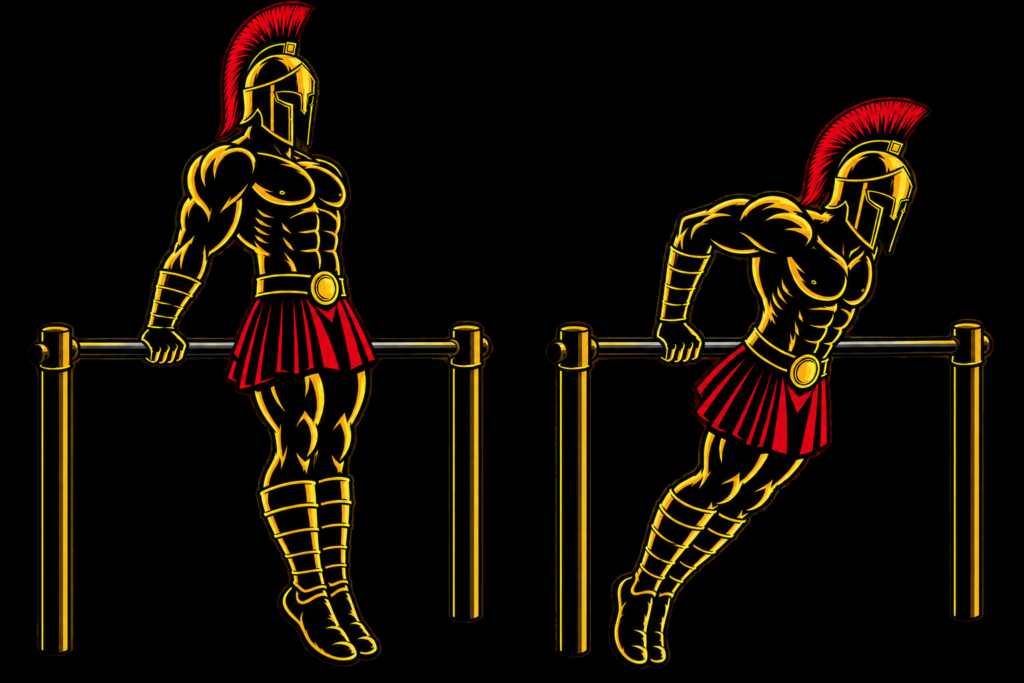
Korean Dips Form Checklist
Use this quick checklist to ensure proper Korean Dip form.
- Grip the bars firmly
- Keep your core engaged
- Maintain your body behind the bars
- Control the descent
- Keep your shoulders stable
- Avoid dropping into the bottom position
- Use a comfortable range of motion
- Press smoothly back to the top
The Korean Dip is an advanced movement, so quality repetitions are much more valuable than chasing maximum depth or repetitions.
Common Korean Dip Mistakes
Dropping Too Quickly
Problem: Dropping into the bottom position can place excessive stress on the shoulders.
Fix: Lower yourself slowly and maintain muscular control throughout the entire descent.
Going Too Deep
Problem: Forcing excessive shoulder extension can cause discomfort and reduce control.
Fix: Use a range of motion that your current shoulder mobility and strength can safely control.
Losing Core Tension
Problem: A loose midsection makes the movement harder to control.
Fix: Brace your core and keep your body stable throughout every repetition.
Using Momentum
Problem: Swinging or bouncing reduces muscular control and can increase stress on the shoulders.
Fix: Perform each repetition slowly and deliberately.
Attempting Korean Dips Too Early
Problem: Insufficient dip strength or shoulder mobility can make this exercise unnecessarily risky and difficult.
Fix: Build a strong foundation with regular dips, assisted Korean Dips, and other controlled progressions before attempting full repetitions.
Advanced exercises should be earned through progressive strength development.
Korean Dip Progressions and Variations
Once you have developed a strong foundation, these progressions can help you work toward a full Korean Dip.
Assisted Korean Dips
The best starting progression for learning the movement.
How to Do Assisted Korean Dip
- Use a resistance band for assistance.
- Position your body behind the bars.
- Lower yourself slowly.
- Use the band to reduce the amount of bodyweight you need to control.
- Gradually reduce assistance as you become stronger.
Negative Korean Dips
Builds strength during the lowering phase.
How to Do Negative Korean Dip
- Start at the top position with assistance if necessary.
- Position your body behind the bars.
- Slowly lower yourself toward the bottom.
- Take several seconds to complete the descent.
- Return to the top using assistance.
Partial Korean Dips
Allows you to develop strength without immediately using the full range of motion.
How to Do Partial Korean Dip
- Start in the Korean Dip position.
- Lower yourself through a comfortable range.
- Pause briefly.
- Press yourself back up.
- Gradually increase your depth as your strength improves.
Full Korean Dips
The advanced variation.
How to Do Full Korean Dip
- Support yourself on the parallel bars.
- Position your body behind the bars.
- Lower yourself under complete control.
- Maintain stable shoulders and a tight core.
- Press through the bars to return to the starting position.
Only perform full Korean Dips when you can control the movement without pain or excessive shoulder stress.
Final Thoughts
The Korean Dip is a challenging advanced calisthenics exercise that demands considerable upper-body strength, shoulder mobility, and body control.
It develops:
- Triceps strength
- Chest strength
- Shoulder stability
- Core control
- Dip strength
- Advanced bodyweight coordination
If you’re new to Korean Dips, don’t rush straight into full repetitions. Build your foundation with regular dips, assisted variations, and controlled negatives before progressing to the complete movement. Learn more about Push Workouts here.
Most importantly, never force the range of motion. The goal is to become stronger while maintaining control and healthy movement.
Master the basics, respect the progression, and let your strength earn the advanced skill.
Essential Gear for Korean Dips
Korean Dips require stable equipment because the exercise places significant demands on your upper body and shoulders.
- Parallel Dip Bars: The primary equipment required for performing Korean Dips.
- Resistance Band: Useful for assisted Korean Dips and controlled progression work.
- Gymnastics Rings: Can be used for advanced variations, although they significantly increase the demands on stability.
- Exercise Mat: Provides cushioning underneath the bars during training and progression drills.
- Gym Chalk: Enhances grip and prevents slipping during sets.
Korean Dip FAQ
Q1: Are Korean Dips harder than regular dips?
Yes. Korean Dips are considerably more demanding because they place the body behind the bars and require greater shoulder control, mobility, and upper-body strength.
Q2: Should beginners do Korean Dips?
Beginners should first develop a strong foundation with regular dips and basic upper-body strength. Assisted Korean Dips and negative repetitions can then be used as progressions.
Q3: How many Korean Dips should I do?
Because Korean Dips are an advanced exercise, start with 2-5 controlled repetitions for 2-3 sets. Prioritize technique and shoulder control rather than high repetition counts.