Learn how to do Cossack Squats with perfect form, avoid common mistakes, and discover the best Cossack Squat variations to build lower-body strength, improve hip mobility, and develop greater balance and flexibility.
The Cossack Squat is a powerful bodyweight exercise that combines strength, mobility, balance, and coordination. Unlike a traditional squat, the Cossack Squat trains one leg while the opposite leg remains extended, creating a deep lateral movement that challenges your hips, adductors, hamstrings, and ankles.
Whether you’re training for calisthenics, martial arts, athletic performance, or general fitness, mastering the Cossack Squat can improve both your lower-body strength and movement quality.
What Is a Cossack Squat?
A Cossack Squat is a unilateral squat variation performed by shifting your body weight onto one bent leg while extending the opposite leg out to the side. The working leg bends deeply while the extended leg remains relatively straight, with the foot either planted or turned upward depending on your mobility and technique.
Unlike forward or backward lunges, the Cossack Squat moves laterally and places a greater emphasis on hip mobility and the inner thighs.
Cossack Squats are commonly used in:
- Calisthenics training
- Mobility routines
- Martial arts conditioning
- Athletic strength programs
- Warm-up and movement preparation
- Functional lower-body workouts
The exercise is especially valuable for athletes who need strength and mobility in multiple planes of movement.
Benefits of Cossack Squats
Cossack Squats offer several strength, mobility, and athletic benefits.
Benefits include:
- Builds single-leg strength
- Improves hip mobility
- Stretches the inner thighs
- Improves ankle mobility
- Strengthens the quadriceps and glutes
- Develops balance and coordination
- Improves lateral movement ability
- Requires no equipment
Few bodyweight exercises combine lower-body strength and lateral mobility as effectively as the Cossack Squat.
Muscles Worked in Cossack Squats
Cossack Squats engage several major muscles throughout the lower body.
Primary Muscles
- Quadriceps
- Gluteus Maximus
- Adductors
- Hamstrings
Secondary Muscles
- Gluteus Medius
- Calves
- Hip Flexors
- Tibialis Anterior
- Core Muscles
The extended leg also receives a significant stretch, making the Cossack Squat both a strengthening exercise and a mobility movement.
How to Do Cossack Squats (Step-by-Step)
Step 1: Stand With a Wide Stance
Stand upright with your feet considerably wider than shoulder-width apart.
Maintain:
- Chest lifted
- Core engaged
- Toes pointing mostly forward or slightly outward
- Weight distributed evenly between both feet
Tip: Use a stance wide enough to allow you to descend comfortably without forcing your hips.
Step 2: Shift Your Weight to One Side
Slowly transfer your body weight onto your right leg.
Keep your left leg extended to the side.
As you shift:
- Keep your right foot flat
- Keep your left leg straight
- Maintain an upright torso
- Keep your core engaged
Step 3: Lower Into the Cossack Squat
Bend your right knee and lower your hips toward the floor.
Focus on:
- Keeping your working heel planted
- Driving your knee in the same direction as your toes
- Keeping your extended leg straight
- Maintaining control throughout the descent
Descend only as deeply as your mobility allows.
Step 4: Reach the Bottom Position
At the bottom:
- Keep your working foot firmly planted
- Keep your extended leg straight
- Keep your chest lifted
- Maintain a neutral spine
Your extended leg may remain flat on the floor or have the heel lifted, depending on your mobility and the variation being performed.
Pause briefly if you can maintain good form.
Step 5: Push Back to the Starting Position
Drive through the heel and midfoot of your working leg.
Straighten your working knee and shift your body back to the center.
Return to the starting position before repeating on the opposite side.
Perform equal repetitions on both sides.
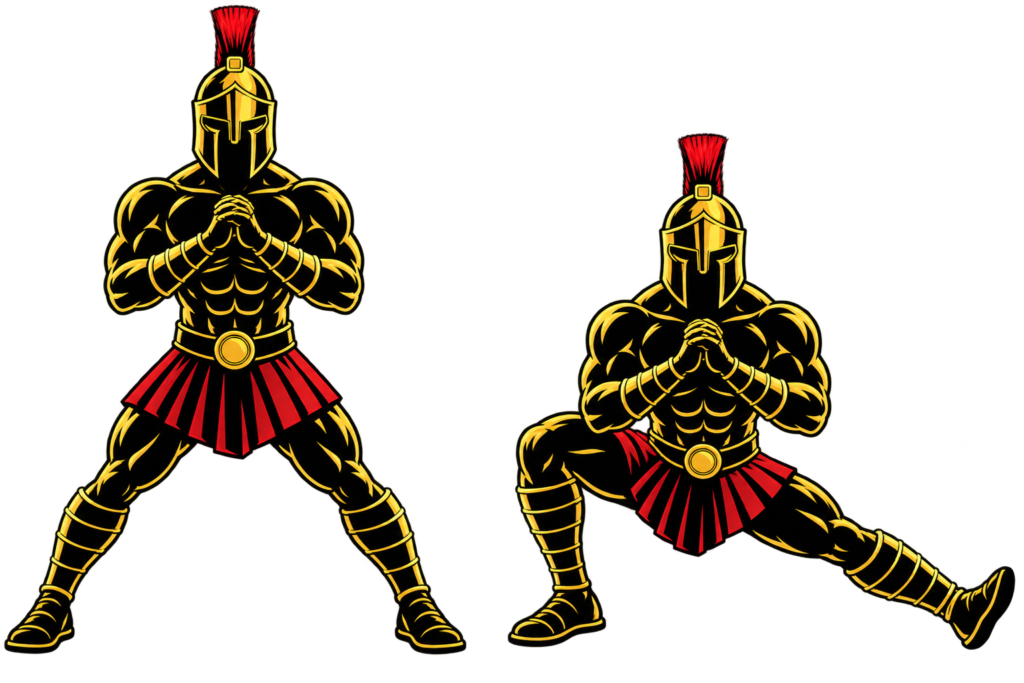
Cossack Squats Form Checklist
Use this quick checklist to ensure proper Cossack Squat form.
- Start with a wide stance
- Keep your working heel planted
- Keep your extended leg straight
- Keep your chest lifted
- Keep your knee aligned with your toes
- Control the descent and ascent
- Never force your range of motion
Good technique allows you to develop strength while gradually improving mobility.
Common Cossack Squats Mistakes
Using a Stance That Is Too Narrow
Problem: Limits your range of motion and makes it difficult to reach a deep position.
Fix: Widen your stance until you can comfortably shift your hips toward one side.
Letting the Working Heel Lift
Problem: Reduces stability and can make the movement less controlled.
Fix: Work on ankle mobility and keep the working heel firmly connected to the floor.
Collapsing the Working Knee Inward
Problem: Reduces stability and places unnecessary stress on the knee.
Fix: Keep your knee tracking in the same direction as your toes.
Rounding the Back Excessively
Problem: Reduces control and can make the bottom position uncomfortable.
Fix: Keep your chest lifted and maintain a controlled, neutral spinal position.
Forcing the Depth
Problem: Insufficient hip or ankle mobility can make a deep Cossack Squat uncomfortable.
Fix: Only descend as far as you can while maintaining proper technique. Gradually increase your range of motion as your mobility improves.
Controlled movement is more important than achieving maximum depth.
Cossack Squat Variations
Once you master the basic Cossack Squat, these variations can help you progress.
Assisted Cossack Squats
The ideal beginner progression.
How to Do Assisted Cossack Squats
- Hold onto a sturdy object for balance.
- Perform the Cossack Squat while using your arms for minimal assistance.
- Gradually reduce the amount of support as your mobility and strength improve.
Bodyweight Cossack Squats
The standard variation.
How to Do Bodyweight Cossack Squats
- Start with a wide stance.
- Shift your weight onto one leg.
- Lower into the squat while extending the opposite leg.
- Push back to the center and switch sides.
Goblet Cossack Squats
Adds resistance to the movement.
How to Do Goblet Cossack Squats
- Hold a kettlebell or dumbbell close to your chest.
- Perform a controlled Cossack Squat.
- Keep your chest upright throughout the movement.
The added resistance increases the strength demands on the working leg.
Weighted Cossack Squats
The advanced progression.
How to Do Weighted Cossack Squats
- Hold a dumbbell, kettlebell, or other suitable weight.
- Perform a full Cossack Squat through your comfortable range of motion.
- Maintain control throughout every repetition.
Increase the resistance gradually while preserving proper form.
Final Thoughts
The Cossack Squat is one of the best bodyweight exercises for developing lower-body strength and lateral mobility.
It improves:
- Single-leg strength
- Hip mobility
- Ankle mobility
- Balance
- Lateral movement
- Lower-body flexibility
Unlike traditional squats, the Cossack Squat challenges your body in the frontal plane while simultaneously strengthening one leg and stretching the other. Learn more about Leg Workouts here.
Start with a comfortable range of motion and gradually work toward greater depth. Never sacrifice control simply to reach the floor.
Strong legs are important, but a warrior who can move freely is even harder to stop.
Essential Gear for Cossack Squats
Cossack Squats require no equipment, but a few pieces of gear can make your training more comfortable and allow you to progress.
- Exercise Mat: Provides cushioning and grip during mobility-focused Cossack Squat sessions.
- Kettlebell: Excellent for adding resistance with Goblet Cossack Squats.
- Dumbbell: Provides another simple option for progressively loading the movement.
- Resistance Band: Can be used for assisted Cossack Squats or added resistance during advanced variations.
Cossack Squat FAQ
Q1: Are Cossack Squats good for beginners?
Yes. Beginners can perform assisted Cossack Squats while holding a sturdy support. Start with a comfortable range of motion and gradually build strength and mobility.
Q2: Why can’t I get very low in a Cossack Squat?
Limited hip, ankle, or inner-thigh mobility can restrict your depth. Use an assisted variation and gradually increase your range of motion instead of forcing yourself into a deeper position.
Q3: Should my extended foot stay flat on the floor?
It depends on your mobility and the variation. Keeping the extended leg straight is more important than forcing the entire foot to remain flat. Allow your foot to adjust naturally if necessary.