If you’re serious about building a strong back, powerful arms, and real grip strength…
You need ONE thing:
A pull-up bar.
No gym.
No machines.
No excuses.
But here’s the problem:
Most beginners either:
- Buy the wrong type of bar
- Choose something that doesn’t fit their training space
- Buy a weak doorway bar when they really want a permanent setup
- Or overpay for features they don’t need
This guide fixes that.
Quick Answer (Don’t Overthink It)
⇛ Want the BEST overall setup?
Go for the Foldable Multi-Grip Wall-Mounted Pull-Up Bar
More grip positions and exercise options make it the more versatile choice for a serious home calisthenics setup.
⇛ Want something simple and strong?
Go for the Reinforced Wall-Mounted Pull-Up Bar
It’s a straightforward wall-mounted setup built around the exercises that matter most.
Why a Pull-Up Bar is Non-Negotiable
A pull-up bar can help you build:
- Back strength
- Biceps and forearms
- Grip strength
- Core strength
- Shoulder stability
- Body control
And it unlocks some of the most important exercises in calisthenics:
- Pull-ups
- Chin-ups
- Dead hangs
- Hanging knee raises
- Hanging leg raises
- Scapular pull-ups
- Assisted pull-ups
- Advanced pulling progressions
And the best part?
⇛ You can build serious pulling strength at home.
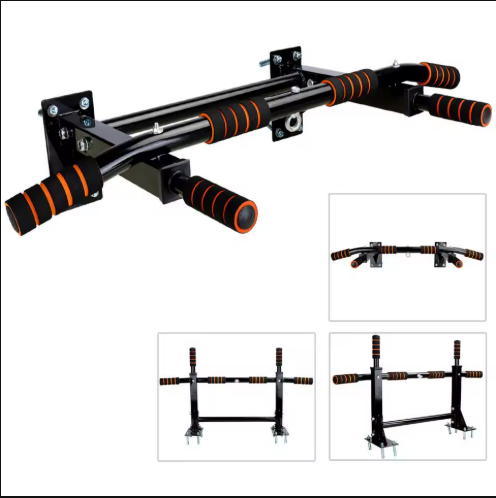
1. Foldable Multi-Grip Wall-Mounted Pull-Up Bar (Best Overall)
Key Features:
- Wall-mounted steel construction
- Multiple grip positions
- Wide-grip handles
- Neutral-grip handles
- Padded gripping areas
- Foldable/adjustable design
- Multiple exercise possibilities
- Designed for permanent home installation
Why This One Wins:
This isn’t just a straight bar attached to a wall.
⇛ It’s a more complete upper-body training station.
The biggest advantage is the variety of grip positions.
Instead of performing every pull-up with exactly the same hand position, you can incorporate different grips into your training.
That gives you options for:
- Standard pull-ups
- Wide-grip pull-ups
- Neutral-grip pull-ups
- Chin-up variations
- Dead hangs
- Hanging knee raises
- Hanging leg raises
- Scapular work
- Core training
The additional handles also make this much more versatile than a basic straight pull-up bar.
And because the design is foldable, it can make more sense for a home training area where you don’t want the equipment permanently sticking far out from the wall.
Pros:
✓ Multiple grip positions
✓ More exercise variety
✓ Foldable design
✓ Wall-mounted setup
✓ Useful for both pulling and core exercises
✓ Better long-term versatility
Cons:
❌ Requires proper wall installation
❌ More complicated than a basic pull-up bar
❌ Requires enough wall and training space
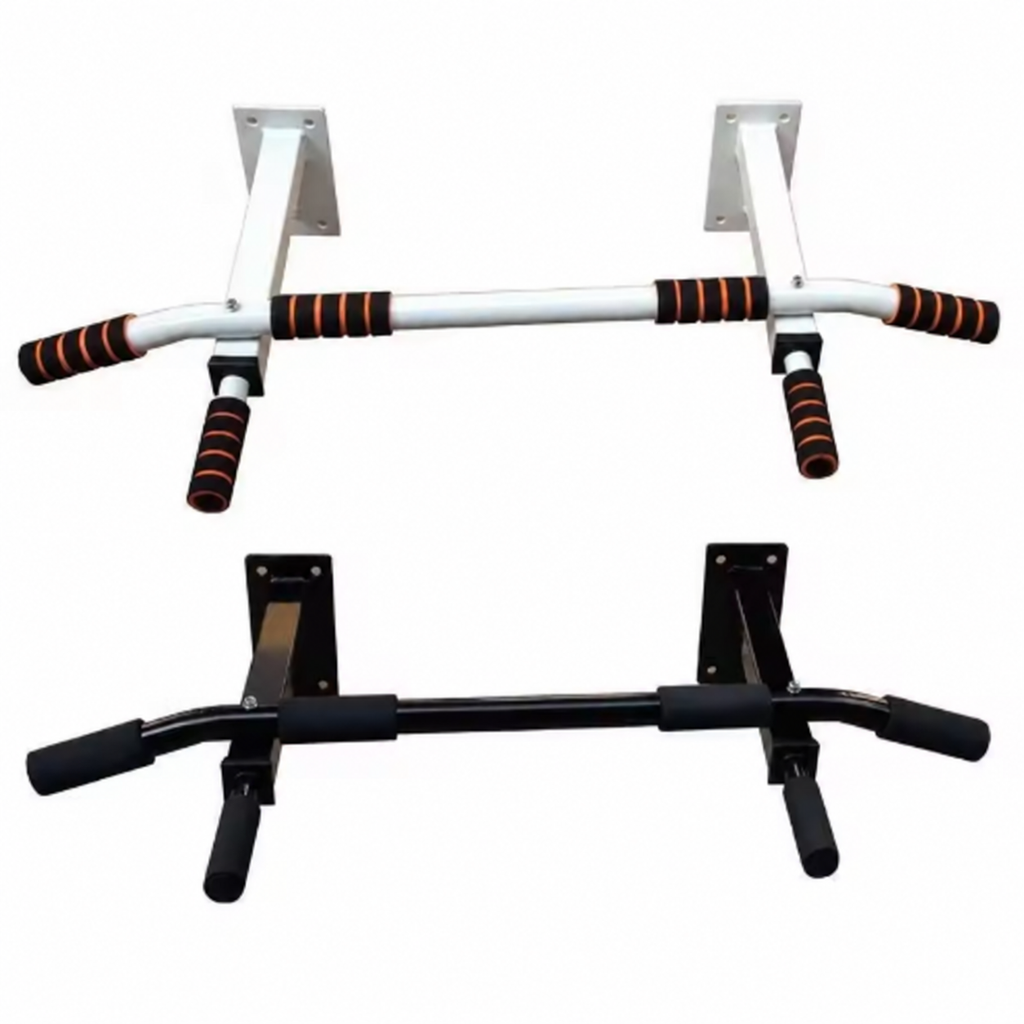
2. Reinforced Wall-Mounted Pull-Up Bar (Simple & Strong)
Key Features:
- Reinforced steel construction
- Wall-mounted design
- Multiple grip positions
- Padded handles
- Approximately 94 cm wide on the larger configuration shown
- Approximately 50 cm projection from the wall
- 32 mm tubing shown on the larger configuration
- Multiple versions available
Why Choose This:
If you want:
⇛ “Just give me a proper wall-mounted bar and let me train.”
This is it.
No need for a complicated training station.
Mount it securely, and you’ve got a permanent place for:
- Pull-ups
- Chin-ups
- Dead hangs
- Hanging knee raises
- Hanging leg raises
- Scapular pull-ups
- Assisted pull-ups
The larger configuration shown also extends roughly 50 cm from the wall, giving your body more clearance than a bar mounted extremely close to the surface.
That matters during hanging exercises.
Pros:
✓ Simple wall-mounted design
✓ Multiple hand positions
✓ Reinforced construction
✓ Good wall clearance on the larger version
✓ Suitable for the essential pulling exercises
✓ Less complicated than Product 1
Cons:
❌ Requires permanent installation
❌ Less versatile than Product 1
❌ Different configurations have different dimensions and features
Comparison – Choose Your Arsenal
| Feature | Foldable Multi-Grip Bar | Reinforced Wall-Mounted Bar |
|---|---|---|
| Wall-Mounted | Yes | Yes |
| Multiple Grips | Yes | Yes |
| Foldable Design | Yes | No |
| Exercise Variety | Excellent | Good |
| Simplicity | Good | Excellent |
| Best For | Complete home setup | Essential pull-up training |
| Our Pick | Best Overall | Simple & Strong |
Beginner Plan
Listen carefully—this is where most people fail.
Even with the BEST pull-up bar, you won’t progress if you don’t train smart.
Start with:
- Band-assisted pull-ups
- Negative pull-ups
- Dead hangs
- Scapular pull-ups
- Hanging knee raises
- Full pull-ups as your strength improves
⇛ Train 3–4 times/week
Start simple.
Build your grip, back, and arm strength.
Then gradually reduce assistance until you can perform clean pull-ups with your own bodyweight.
Important Buying Advice
Before you click:
Make sure your wall can actually support a wall-mounted pull-up bar.
A pull-up bar experiences more than just your static bodyweight.
You’re repeatedly hanging, pulling, lowering, and potentially swinging from it.
That’s why installation matters just as much as the bar itself.
Check Your Wall
A solid structural surface such as concrete or solid masonry is generally a much more appropriate mounting surface than weak or hollow material.
Do not assume every wall is suitable.
If Direct Mounting Isn’t Practical
If the pull-up bar’s mounting holes don’t line up with suitable fixing points on your wall, another option may be to install a strong wooden mounting frame or backer first, then attach the pull-up bar to that.
The wooden frame can provide a larger mounting surface and give you more flexibility when positioning the bar.
However, the frame itself must be securely anchored into a suitable structural wall or framing—not simply attached to weak plaster, hollow material, or another surface that cannot safely support your bodyweight and the forces created during training.
⇛ The wooden frame is only as strong as the structure holding it.
Check Your Space
You need enough room:
- Below the bar for a full hang
- In front of the wall for your body
- Above the bar if you plan to progress toward muscle-ups or similar skills
- Around the handles for different grip positions
Product 2’s larger configuration shown extends approximately 50 cm from the wall, so measure your available space before ordering.
Check the Exact Version
This is especially important with these listings.
Different configurations can have:
- Different dimensions
- Different handles
- Different designs
- Different prices
⇛ Don’t buy based only on the main product photo.
Check that the exact option selected in the listing is the one you actually want.
And remember:
⇛ The strongest-looking bar is useless if it isn’t installed correctly.
Final Verdict
⇛ Want maximum versatility?
Go for the Foldable Multi-Grip Wall-Mounted Pull-Up Bar.
The multiple grip positions, additional handles, foldable design, and greater exercise variety make Product 1 the stronger all-around option for a dedicated home calisthenics setup.
This is my Best Overall pick.
⇛ Want something simpler?
Go for the Reinforced Wall-Mounted Pull-Up Bar.
It gives you the essentials without turning your wall into an entire workout station.
Pull-ups.
Chin-ups.
Hangs.
Core work.
That’s enough to build serious strength.
But if both fit your budget and your wall?
I’d take Product 1.
The additional versatility gives you more room to progress.
Final Words
You don’t need a gym.
You don’t need fancy machines.
You need:
- A pull-up bar
- Proper technique
- Progressive training
- Consistency
- Discipline
Start with hangs.
Build your first pull-up.
Build your reps.
Then keep progressing.
Install it properly.
Start training.
Affiliate Disclosure: WarriorBodyAcademy may earn a commission when you purchase through affiliate links in this article, at no extra cost to you. We only recommend products that we believe are useful for our readers and training community.
Comments are closed.