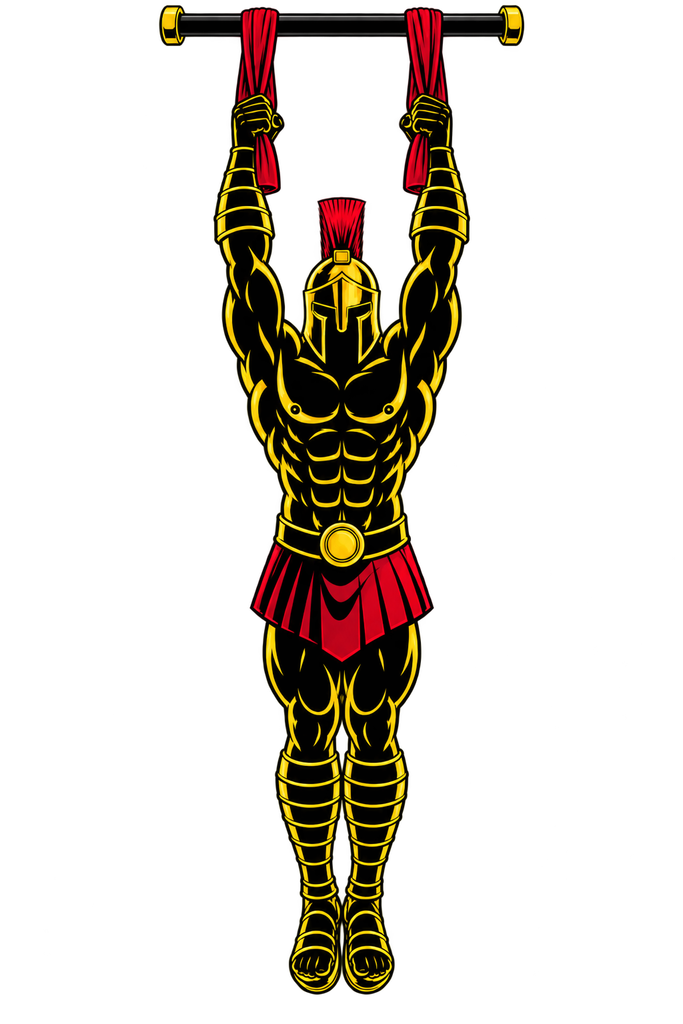
The Towel Hang is a challenging grip exercise where you hang one or more strong towels over a secure Pull-Up Bar and support your bodyweight by gripping the towel instead of the bar.
Compared with a standard Dead Hang, the towel creates a thicker, less rigid gripping surface. This puts greater demands on your fingers, hands, and forearms, making the exercise useful for developing grip strength and endurance.
Towel Hangs are especially useful for calisthenics athletes, climbers, grapplers, obstacle-course athletes, and anyone looking to make basic hanging exercises more grip-intensive.
What Is a Towel Hang?
A Towel Hang is a bodyweight hanging exercise in which a strong towel is securely draped over a Pull-Up Bar and used as the gripping surface.
Instead of wrapping your hands directly around the bar, you squeeze the hanging ends of the towel and suspend your body underneath it.
The towel’s thickness and flexible surface make maintaining your grip more difficult than during a standard Dead Hang. Your fingers must squeeze firmly to prevent the towel from slipping through your hands.
Towel Hangs are commonly used in:
- Grip-strength training
- Forearm training
- Calisthenics workouts
- Pull-Up training
- Climbing-related training
- Grappling and combat-sport conditioning
- Obstacle-course preparation
- Bodyweight workouts
Because your bodyweight depends on the towel and your grip, both the towel and Pull-Up Bar must be capable of safely supporting the exercise.
Benefits of Towel Hangs
Towel Hangs provide a simple way to make bodyweight hanging significantly more demanding on your grip.
Benefits include:
- Builds grip strength
- Develops grip endurance
- Strengthens the fingers and hands
- Challenges the forearm muscles
- Develops support for towel-based pulling exercises
- Provides a harder progression from standard Dead Hangs
- Requires minimal equipment
- Can improve hanging endurance
- Provides grip-specific training for climbing and grappling activities
Towel Hangs can be highly demanding even when your standard Dead Hang is already strong, so begin with manageable hold times rather than immediately attempting maximum-duration sets.
Muscles Worked in Towel Hangs
Towel Hangs primarily challenge the muscles responsible for maintaining your grip, while several other upper-body muscles contribute to maintaining a controlled hanging position.
Primary Muscles
- Finger Flexors
- Forearm Flexors
- Hand and Grip Muscles
Secondary Muscles
- Brachioradialis
- Biceps Brachii
- Brachialis
- Latissimus Dorsi
- Trapezius
- Rotator Cuff Muscles
- Core Muscles
The towel’s thickness and tendency to move make your fingers and forearms work particularly hard to prevent your hands from sliding.
How to Do a Towel Hang (Step-by-Step)
Step 1: Choose a Strong Towel and Secure Pull-Up Bar
Use a sturdy towel that is large and strong enough for hanging exercises.
Inspect both your towel and Pull-Up Bar before every session.
Check for:
- Tears
- Fraying
- Weak seams
- Damaged fabric
- Excessive wear
- A loose Pull-Up Bar
- Damage to the supporting structure
Do not use a towel simply because it feels thick. It must be structurally sound enough for the exercise.
Step 2: Position the Towel Over the Bar
Drape the middle of the towel over a secure Pull-Up Bar so that both ends hang downward.
Try to keep the two hanging sections reasonably even.
Make sure the towel sits securely over the bar and cannot easily slide off the side.
Step 3: Grip the Towel
Take one hanging end in each hand.
Wrap your fingers firmly around the fabric and squeeze tightly.
Keep your:
- Hands secure
- Wrists comfortable
- Arms extended
- Body close to underneath the towel
Your exact grip will depend on the thickness and shape of the towel, but you should be able to maintain firm contact without the fabric unexpectedly slipping through your fingers.
Step 4: Transfer Your Bodyweight Gradually
Use a stable step or platform if necessary.
Begin transferring your bodyweight into your hands gradually while keeping your feet supported.
This allows you to test:
- Your grip
- The towel
- The Pull-Up Bar
- The towel’s position on the bar
Do not immediately jump into a full bodyweight hang without first confirming that the setup is secure.
Step 5: Enter the Towel Hang
Once your setup feels secure, gradually lift your feet from the floor or platform.
Allow your body to hang beneath the towel with your arms extended.
Keep your:
- Grip tight
- Head neutral
- Body controlled
- Legs relatively still
- Breathing natural
Your knees can remain slightly bent if necessary for floor clearance.
Step 6: Hold the Position
Maintain the Towel Hang for as long as you can safely control your grip and body position.
Beginners to towel-specific grip training can start with short holds of approximately 5-15 seconds.
During the hold:
- Squeeze the towel firmly
- Keep your arms extended
- Minimize swinging
- Breathe normally
- Monitor your grip
- Keep your body controlled
End the set before the towel begins uncontrollably slipping through your hands.
Step 7: Dismount Safely
Bring your feet back onto the floor or a stable platform.
Gradually transfer your bodyweight away from your hands before releasing the towel.
Do not intentionally hang until your grip suddenly fails.
Rest your hands and forearms before beginning another set.
Towel Hang Form Checklist
Use this checklist to maintain proper Towel Hang technique.
- Use a strong and undamaged towel
- Use a secure Pull-Up Bar
- Inspect your setup before every session
- Drape the towel securely over the bar
- Grip one end in each hand
- Squeeze the fabric firmly
- Test the setup with partial bodyweight first
- Transfer your bodyweight gradually
- Keep your arms extended
- Maintain a neutral head position
- Keep your body controlled
- Minimize swinging
- Breathe normally
- Monitor your grip throughout the hold
- End the set before uncontrolled grip failure
- Dismount onto a stable surface
Grip security should always take priority over achieving a longer hold.
Common Towel Hang Mistakes
Using a Weak or Damaged Towel
Problem: A towel with worn fabric, damaged seams, or tears may not be suitable for supporting bodyweight.
Fix: Inspect the entire towel before training and replace it if there is any doubt about its structural condition.
Hanging From an Unstable Bar
Problem: Even a strong towel cannot make an unsafe Pull-Up Bar suitable for hanging.
Fix: Use a properly installed Pull-Up Bar or another structure specifically capable of safely supporting your bodyweight and the forces created during hanging.
Jumping Straight Into the Hang
Problem: Jumping and suddenly loading the towel gives you little opportunity to identify a poor grip or unsafe setup before your full bodyweight is suspended.
Fix: Use a stable platform and gradually transfer weight into your hands before lifting your feet.
Hanging Until Your Grip Fails
Problem: Towel Hangs can cause rapid grip fatigue, and unexpectedly losing the towel can result in an uncontrolled fall.
Fix: End your set while you can still securely hold the towel and control your dismount.
Allowing the Towel to Slip Through the Hands
Problem: A gradually slipping grip can quickly become an uncontrolled grip failure.
Fix: Squeeze firmly and finish the set when you can no longer maintain a secure hand position.
Using Excessive Swinging
Problem: Swinging makes the exercise harder to control and places changing forces through your grip and hanging setup.
Fix: Enter the hang gradually and keep your torso and legs relatively still.
Progressing Too Quickly
Problem: Towel Hangs can be considerably harder on the grip than standard Dead Hangs.
Fix: Begin with short holds and gradually increase duration or difficulty as your hands and forearms adapt.
Towel Hang Variations
Towel Hangs can be modified to make the exercise easier or more difficult according to your grip strength.
Assisted Towel Hang
This variation allows your legs to support part of your bodyweight.
How to Do an Assisted Towel Hang
- Drape a strong towel over a secure Pull-Up Bar.
- Grip one end in each hand.
- Keep your feet on the floor or a stable platform.
- Gradually transfer some bodyweight into your hands.
- Keep your arms extended.
- Hold the towel firmly.
- Use your legs to control the difficulty.
Standard Two-Hand Towel Hang
This is the standard full-bodyweight variation.
How to Do a Standard Two-Hand Towel Hang
- Drape a strong towel over the bar.
- Hold one end in each hand.
- Test the setup with partial bodyweight.
- Lift your feet from the floor.
- Hang with your arms extended.
- Keep your body controlled.
- Hold while your grip remains secure.
- Dismount before grip failure.
Two-Towel Hang
Using two separate towels provides an independent towel for each hand.
How to Do a Two-Towel Hang
- Drape two strong towels securely over the bar.
- Position them approximately shoulder-width apart.
- Grip both ends of one towel with one hand and both ends of the other towel with the other hand, or use another secure configuration appropriate to the towels.
- Test both towels before fully hanging.
- Lift your feet gradually.
- Maintain a controlled hang.
- Dismount safely.
Make sure both towels are equally suitable for supporting the exercise.
Towel Hang With Active Shoulders
This variation combines the grip challenge of a Towel Hang with the shoulder engagement of an Active Hang.
How to Do a Towel Hang With Active Shoulders
- Enter a standard Towel Hang.
- Keep your elbows straight.
- Draw your shoulder blades downward under control.
- Allow your torso to rise slightly.
- Maintain a strong towel grip.
- Hold briefly.
- Return gradually to the starting hang.
Single-Arm Assisted Towel Hang
This advanced variation increases the grip demand on one hand while the opposite arm provides assistance.
How to Do a Single-Arm Assisted Towel Hang
- Secure a strong towel over the bar.
- Grip the towel firmly with your working hand.
- Use your opposite hand on the bar or another secure assistance point.
- Gradually shift more bodyweight toward the towel hand.
- Maintain control throughout the hold.
- Keep the assistance necessary to prevent grip failure.
- Dismount safely.
- Repeat on the opposite side.
Do not rush toward unsupported one-arm Towel Hangs. They create substantially greater demands on the working hand, forearm, elbow, and shoulder.
Final Thoughts
The Towel Hang is a simple but demanding progression from the standard Dead Hang that places much greater emphasis on your grip.
It develops:
- Grip strength
- Grip endurance
- Finger strength
- Forearm strength and endurance
- Hanging control
- Towel-specific gripping ability
You do not need long holds to make Towel Hangs challenging. Begin with a strong towel, a secure Pull-Up Bar, short controlled holds, and enough grip strength remaining to dismount safely.
As your grip improves, gradually increase your hold duration or progress to more challenging variations rather than simply hanging until your hands fail. Learn more about Pull Workouts here.
Essential Gear for Towel Hangs
Towel Hangs require only basic equipment, but every part of the setup must be suitable for supporting your bodyweight.
- Strong Towel: The primary gripping surface for the exercise. Use a sturdy, undamaged towel capable of safely tolerating the load rather than an old or weakened towel.
- Pull-Up Bar: Provides the overhead support for the towel. The bar must be securely installed and capable of safely supporting your bodyweight.
- Stable Step or Platform: Helps you reach the towel and gradually transfer your bodyweight into and out of the hang.
- Gym Chalk: Can help improve grip when sweaty hands make the towel difficult to hold securely.
- Weighted Vest or Dip Belt: Ideal for advanced athletes who want to increase resistance and further develop grip strength, scapular control, and upper-body stability.
Towel Hang FAQ
Q1: How long should beginners hold a Towel Hang?
If you are new to towel-specific grip training, short holds of approximately 5-15 seconds can be a practical starting point. Adjust the duration to your current grip strength and end the set before your grip becomes unsafe.
Q2: What kind of towel should I use for Towel Hangs?
Use a strong, durable, undamaged towel that can safely tolerate the exercise. Inspect it for tears, worn fabric, and damaged seams before every session. Do not assume that every household towel is suitable for supporting bodyweight.
Q3: How can I make Towel Hangs harder?
You can gradually increase your hold duration, use two separate towels, incorporate controlled active-shoulder positions, use a weighted vest, or progress toward assisted single-arm variations. Increase difficulty gradually while keeping the towel, bar, and grip secure.